

























































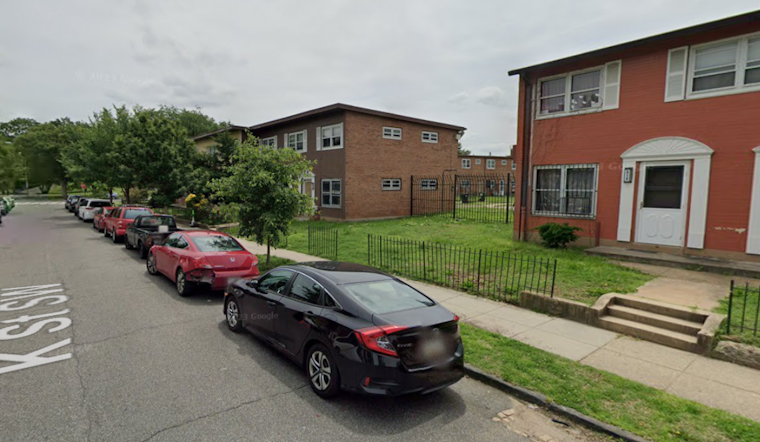
Two men with past convictions are back behind bars after being sentenced for stashing firearms in a criminal hideout dubbed as the "No Rats Allowed" stash house. Leroy Frye, 32, from Waldorf, Md., and Francis White, 28, from Washington, D.C., received prison terms of 60 and 46 months respectively for firearms possession charges, the U.S. Department of Justice reported.
The sentencing followed the revelations from a search warrant executed at 215 K Street, Southwest on November 3, 2021. Court documents reveal that law enforcement officials found a stockpile of illegal substances, including 457 blue pills containing fentanyl, 37 grams of crack cocaine, and around 980 grams of suspected marijuana, in the house referred to by members through text messages as the "Dope Hole." Operating out of the Greenleaf Gardens neighborhood, the "No Rats Allowed" crew has been involved in distributing counterfeit prescription pills laced with fentanyl and has a history of possessing firearms as part of their distribution operations.
The search also led to the recovery of four firearms, three of which were conveniently stored in a kitchen drawer near the drugs. The stash included a .40 caliber semi-automatic pistol and a Glock 17 9mm semi-automatic pistol with a high-capacity magazine, with rounds in the chamber and the magazine. According to court documents, Frye and White admitted to ownership of the FN FNS and Glock 17 pistols, respectively.
Co-defendants in this case have also faced serious sentences. Bartwone Copeland, another member of the crew, was sentenced on May 29, 2024, to a steep 144 months in prison followed by five years of supervised release. Linked by DNA evidence to a pistol found with a "giggle switch," allowing it to operate as a fully automatic weapon, Copeland's conviction included possession of a firearm by a felon and distribution of fentanyl, mentioned by the U.S. Department of Justice. Earlier, on January 10, Adrian Wade received a 60-month term and five years supervised release for his role in carrying a firearm during drug trafficking.
The case, illuminated by the collective efforts of the Metropolitan Police Department and the FBI’s Violent Crime Task Force, was prosecuted by Assistant U.S. Attorneys Justin F. Song and Joshua Gold. Their investigation peeled back the layers of a crew entrenched in drug trafficking and unlicensed gun possession, signaling a continuous battle against the scourge of narcotics and illegal firearms echoing through the streets of D.C.





-4.webp?w=160&h=400&fit=crop&crop=edges)