

























































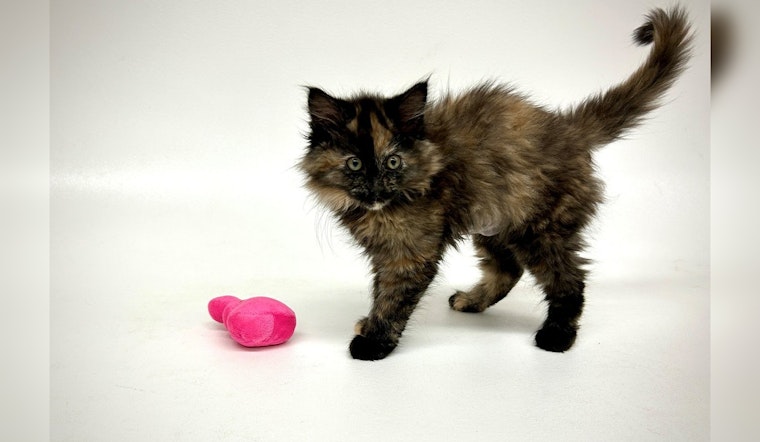
The Humane Society of Central Oregon (HSCO) in Bend has revealed the discovery of an extremely rare intersex tortoiseshell kitten, named Cinder. Initially brought to their attention in April, Cinder was identified as having the signature tortoiseshell coat pattern typically exclusive to female cats. Yet, a procedure meant to be a routine spay surgery unearthed that Cinder possessed male gonads — a signifying trait that the kitten has a disorder of sexual development, often referred to as hermaphroditism in felines.
Dr. Crystal Bloodworth, the HSCO's medical director, faced the challenge of labeling Cinder within binary classifications. "To call it a male is tough, but with the binary nature of animals and people's perception of animals, we chose male," Dr. Bloodworth told KPTV. The kitten, having no uterus or ovaries but equipped with testicles and what looks like a vulva, confirms Cinder's exceptional case in the animal kingdom.
The shelter suspects Cinder to be a three-sex-chromosome cat (XXY), combining two X chromosomes — allowing for the tortoiseshell coloring — with a Y chromosome, facilitating the development of testicles. Wide-ranging expressions of hermaphroditism occur in felines, but the triple-sex-chromosome configuration remains a rarity.
In an interview, HSCO Clinic Manager Bailey Shelton mused over the surreal experience, comparing Cinder to a mythical creature. "It was like spotting a unicorn," Shelton told KOIN. With nine years in the veterinary field, she suggests a sighting of this nature might just be a once-in-a-career event. Despite Cinder's unusual genetics, the kitten has been described by its foster family as a typical, affectionate, adventuresome, and playful kitten, unfettered by the biological curiosity it presents.
The Humane Society is currently in the process of selecting a suitable future owner for the special kitten.





