

























































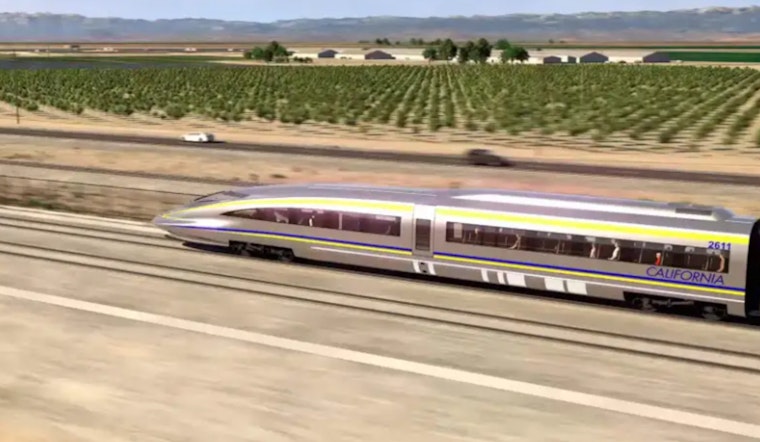
California's ambition to forge a modern transportation continuum took a defining step as the High Desert Corridor Joint Powers Agency inked pivotal labor agreements earlier this week. In a concerted push, they signed on a touted Community Workforce Agreement and a Memorandum of Understanding aimed at bolstering the High Desert Corridor High Speed Rail Project, KTNV reports. These contracts are set to harness skilled union labor that will construct, operate, and maintain the upcoming 54-mile connection.
These agreements didn't materialize in isolation; they're part of a grander scheme that envisions a seamless transition between the sparkling city of Las Vegas and multiple Californian locales. As the gears turn with these initiatives, the project promises a substantial economic infusion to the tune of $12 billion in the region. Furthermore, the labor accords embrace over 16 unions and, according to KTLA, they materialized after a year of diligent planning facilitated by the US High Speed Rail Association.
What lies ahead is a 218-mile vista of connectivity, with automotive veins stretching alongside Interstate 15. The railway will boast stations in Victor Valley, Hesperia, and Rancho Cucamonga, tying distant dots across the golden state and beyond. Significantly, such a project doesn't shy from challenges, as it grapples with extreme weather conditions inherent to desert landscapes. UNLV College of Engineering professor Hualiang Teng, expounded on these challenges, mentioned on KNTV, "To lay rails on the railroad track, you need to know the highest and lowest temperatures the track will be subject to throughout the year and the track geometrics such as horizontal and vertical curves." He further elaborated on the technical intricacies essential for the successful laying of tracks, referencing insights from experiences in the Middle East.
The project's impact reverberates through a narrative of promising economic and infrastructural reinvention. A burgeoning alliance is hence crafted between the existing Brightline West and the California High-Speed Rail ventures. With Brightline West's ground-breaking that took place in April, an anticipatory fervor surrounds the Nevada-California connection. A bevy of trains replicating a well-orchestrated dance, fifty in number, will script the daily commute, departing every 45 minutes in a bid to shuttle commerce and connectivity across state lines, as detailed by documents obtained by the companies behind the project.
Yet, the station locations prompt a secondary transit consideration, positioning them as juggernauts near Silverado Ranch Boulevard and Blue Diamond road in Las Vegas, while the Rancho Cucamonga stop sits as an outpost approximately 40 miles from downtown Los Angeles. For travelers, reaching the pulsating hearts of these cities necessitates additional transit arrangements, from taxis to ride-booking services, mapping the last mile of their journey. Also noteworthy is the financial landscape of this enterprise, with federal support clocking in at $3 billion in taxpayer money, complemented by the potential of $3.5 billion in tax-exempt bonds, underscoring the robust fiscal architecture supporting this transformative rail odyssey.




