

























































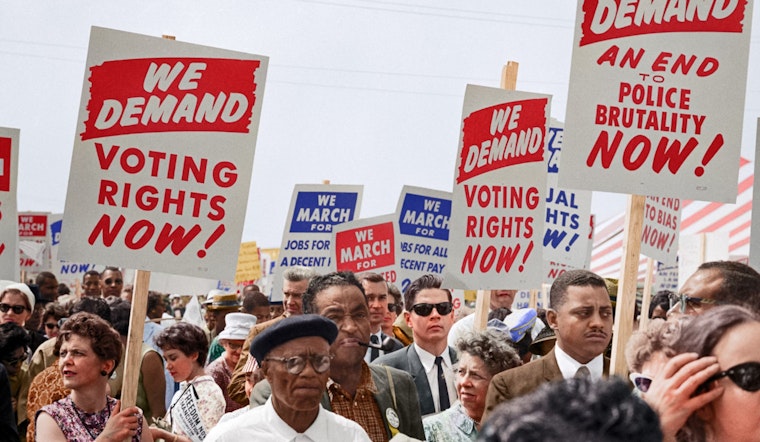
In the midst of an already heated debate around voting rights, civil rights organizations have taken an unexpected detour in their legal strategy. Instead of pursuing an appeal to the U.S. Supreme Court, these groups have let a crucial filing deadline lapse, an indication that they’re shifting their approach to challenging a contentious redistricting plan in Arkansas. According to GPB News, the American Civil Liberties Union (ACLU) and others are now reevaluating their options after a series of defeats in lower courts.
Last year, U.S. District Judge Lee Rudofsky, threw a curveball by ruling that private individuals or groups like the ACLU, could not sue under the Voting Rights Act’s Section 2, putting the enforcement capabilities of this crucial legislation in jeopardy across seven states. This followed Justice Neil Gorsuch’s comments that left open the question of whether private parties had the standing to sue. In an attempt to adapt, civil rights groups have eyed another legal pathway using Section 1983, an evolved statute from the Ku Klux Klan Act.
This legal pivot has raised questions about the effectiveness of the Voting Rights Act, which has already been weakened by the Supreme Court since 2013. With private parties having spearheaded most lawsuits under Section 2, the recent challenge to their ability to enforce this section suggests a significant shift in the voting rights landscape. Critics, including Arkansas Attorney General Tim Griffin, have been quick to declare the situation as a victory for the state, with Griffin stating "For far too long special interests groups have used Section 2 to hijack redistricting decisions and dictate how states conduct elections," as reported by GPB News.
Despite the setbacks, ACLU’s Voting Rights Project director, Sophia Lin Lakin, remains optimistic. “Black Arkansans’ rights can still be safeguarded,” says Lakin on GPB News, as she contemplates employing Section 1983, which continues to allow individuals to fight back when their civil rights have been violated. Lakin points out that enforcement of Section 2 still proceeds in some capacities, this decision looms as a temporary defensive measure meant to thwart an unfavorable Supreme Court ruling that might stymie ongoing and future lawsuits.
Amid this evolving situation, legal experts are keeping an eye on whether new legislation will emerge from Congress to solidify the private right of action under Section 2, an idea supported by congressional committee reports prior to the 1982 amendments to the Voting Rights Act. "With the uncertainty that this Supreme Court seems to throw into about every matter known to man involving racial discrimination or fairness, particularly in the political system, it seems like the practical value of giving time to possibly get better and more specific legislation from Congress is not the wildest decision ever," commented Kareem Crayton, from the Brennan Center for Justice at New York University’s law school, in his conversation with GPB News.





