

























































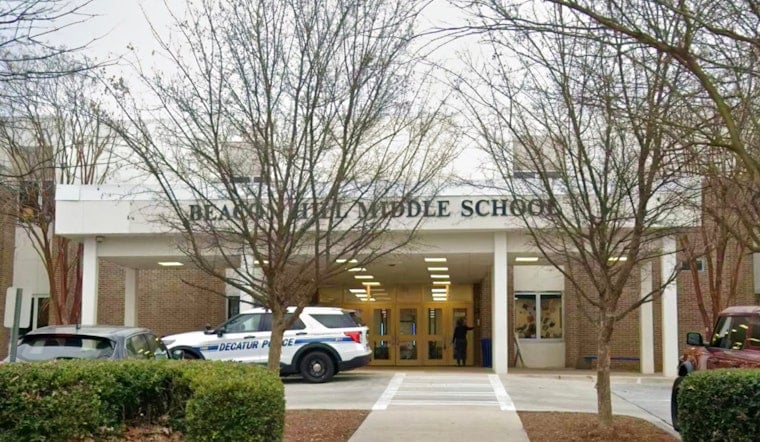
Classroom temperatures inside Beacon Hill Middle School climbed into the 90s on Monday, forcing City Schools of Decatur to send families a text message at 7:40 a.m. Tuesday warning that the school would switch to virtual learning just over an hour before its 8:45 a.m. start time. The scramble came as a punishing heat wave gripped north and central Georgia, pushing feels-like temperatures toward 109 degrees and straining aging school HVAC systems across the metro area.
School officials said intense weather conditions had placed additional strain on the building's HVAC units, according to The Atlanta Journal-Constitution, leaving certain areas of the building without working air conditioning as extreme indoor temperatures set in. Beacon Hill, which serves as City Schools of Decatur's sole middle school for sixth through eighth grade, alerted parents with little room to spare before the school day was set to begin, according to The Local Alert.
Even with instruction moved online, the district kept the physical building open for students who needed somewhere to report, according to 11Alive. Buses still ran on their normal schedule, and the school made bag lunches available for pickup so families without other options for supervision or meals were not left stranded.
A Heat Advisory Stretching Across the State
The National Weather Service issued a heat advisory Tuesday covering Atlanta, Augusta, Columbus, Macon and Albany, per the AJC's reporting. The agency's Peachtree City forecast office extended that advisory through 8 p.m., predicting peak heat index values between 100 and 109 degrees, the article notes. Metro Atlanta temperatures were expected to stay in the upper 90s Wednesday and Thursday, meaning the heat wave was not a one-day event but a sustained stretch that kept overnight lows near 80 degrees and compounded the strain on both people and equipment, as reported by Cobb Courier.
Clayton County Public Schools took a more preemptive approach, canceling all district-sanctioned outdoor activities, including physical education classes and recess, on both Thursday and Monday after National Weather Service data triggered the district's Red Level heat safety threshold, per WSB-TV. Rather than sending students home, the district moved outdoor physical activities indoors and planned to resume normal operations Wednesday, according to the AJC.
Statewide Rules Cover Sports, Not Classrooms
Georgia already has a strict statewide safeguard for student-athletes. Under Georgia High School Association By-Law 2.67, interscholastic sports practices and voluntary conditioning workouts must be halted or delayed whenever the Wet Bulb Globe Temperature reading exceeds 92.0 degrees Fahrenheit, a measurement that factors in humidity, wind, solar radiation and sun angle alongside ambient heat. A peer-reviewed study of Georgia high school football players published in PubMed Central found that enforcing those mandatory WBGT modifications cut heat syncope and heat exhaustion illness rates by 35% to 100% across elevated heat categories, and that before the policy existed, nearly half of heat-related illnesses struck during the first five days of August practice.
No comparable statewide standard governs when an indoor classroom is too hot to teach in, leaving districts like City Schools of Decatur to make case-by-case calls when HVAC systems buckle under prolonged heat loads. That gap sits atop a broader climate trend: Georgia now averages roughly 20 extreme heat days of 90 degrees or higher per year, up from 12 annually in the 1960s, according to the Georgia Department of Public Health, which estimates the toll at about 2,400 emergency department visits or hospitalizations and 20 deaths statewide each year from heat-related illness. State projections cited by the department suggest Georgia could see up to 50 extreme heat days a year by 2050.
A Regional Pattern of Aging Systems Under Strain
Georgia's early August school start date, with City Schools of Decatur opening the 2026-2027 year on August 3, means HVAC systems run continuously through the state's historically hottest stretch, right as mechanical strain peaks. Beacon Hill is not an isolated case in the region: Hoodline previously reported that Greenbrier Middle School in Robertson County, Tennessee, leaned on portable air conditioning units after central cooling failed across eight to ten classrooms as the heat index there hit 105 degrees, with a full system replacement not expected until the 2027-2028 school year.
The same weekend heat wave that eventually forced Beacon Hill offline had already been building for days, with Atlanta's heat index forecast to reach up to 109 degrees over the prior weekend, initiating the multi-day event that strained both human health and mechanical infrastructure before it triggered school disruptions by Tuesday. For families in Decatur, the immediate concern was simpler than any policy debate: getting kids fed, supervised and connected to their lessons while the district waited out the heat and the air conditioning caught up.





