

























































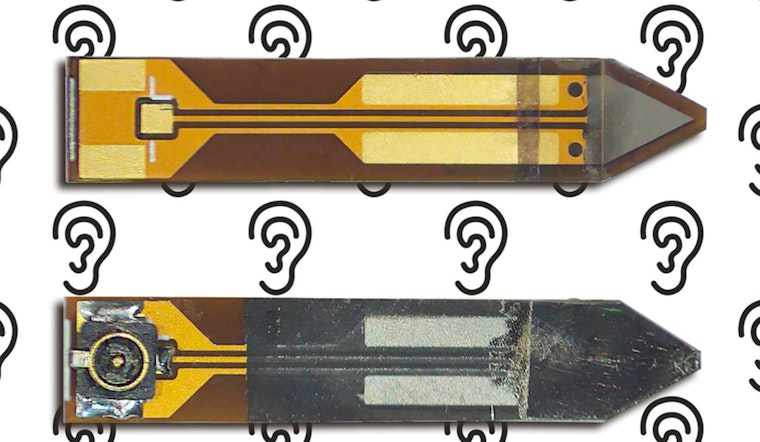
The quest for fully internal cochlear implants has taken a significant step forward thanks to a group of interdisciplinary researchers. Until now, cochlear implants have involved a combination of internal and external components, imposing limitations on the lifestyle and activities of those who use them. Wanting to potentially eliminate these restrictions, MIT, Massachusetts Eye and Ear, Harvard Medical School, and Columbia University have collaborated to create an implantable microphone that rivals the performance of existing external hearing aid microphones, as reported by MIT News.
This device employs a biocompatible piezoelectric material to accurately measure vibrations beneath the eardrum. Piezoelectrics, materials known to generate an electrical charge when manipulated, have been effectively used to transduce the minute vibrations of the ear's umbo into electric signals. To fully harness this capability, researchers were compelled to pair the microphone with a cutting-edge, low-noise amplifier to cleanly enhance the signal. Capturing sound accurately is particularly challenging inside the body, where devices must remain unobtrusively small while still robust enough to operate in a humid and dynamic environment.
The centerpiece of the research is the UmboMic – a tiny sensor, roughly the size of a grain of rice, that could lead to hearing devices devoid of external hardware. According to MIT News, the sensor can pick up the full gamut of human speech, from the subtlest whisper to the widest frequency. Its creators envisage a one-time surgery scenario where the cochlear implant and the internal processor are installed simultaneously, minimizing surgical complexity and patient recovery time.
The development of this microphone entails overcoming technical hurdles, such as working with PVDF, a material that loses piezoelectric properties at relatively low temperatures but essential for its biocompatibility. “Our goal is that a surgeon implants this device at the same time as the cochlear implant and internalized processor, which means optimizing the surgery while working around the internal structures of the ear without disrupting any of the processes that go on in there,” Emma Wawrzynek, an electrical engineering and computer science graduate student and co-lead author of the paper, told MIT News.
Testing on cadaver ear bones has demonstrated the UmboMic's potential, revealing that its sensitivity varies according to individual anatomy. Future in vivo studies are planned to explore these variations further and to evaluate how the device functions post-implantation. As the team moves forward, a key area of focus will be on packaging the sensor to not only be safe for long-term implantation but also to retain the flexibility needed to accurately capture vibrations. These breakthroughs signal a significant stride toward more liberated and seamless auditory assistance for the deaf and hard of hearing community.
Funding for the project has included contributions from the National Institutes of Health, the National Science Foundation, the Cloetta Foundation in Zurich, Switzerland, and the Research Fund of the University of Basel, Switzerland. Peers in the field, such as Karl Grosh, professor of mechanical engineering at the University of Michigan who was not involved in the study, recognize the potential impact of this research. He noted the unexpected performance of the sensor and its competitive stance with commercial microphones, setting a clear precedent for the future of acoustic sensors in medical devices.





