

























































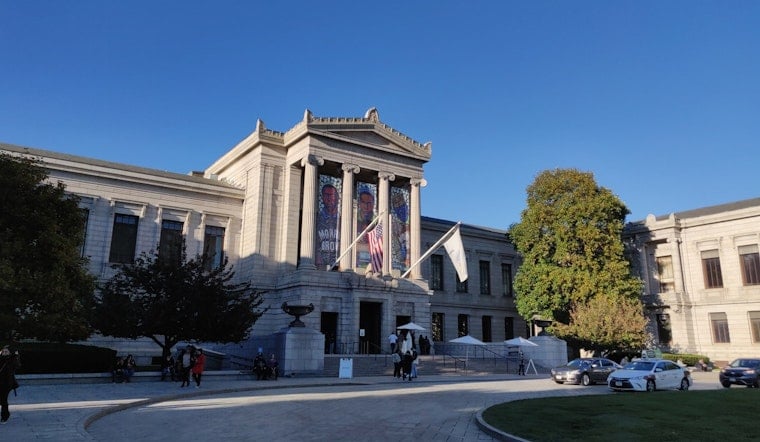
A painting no bigger than a postcard is sitting in storage at the Museum of Fine Arts, Boston, caught in the middle of one of the largest unresolved art restitution disputes to come out of World War II. The 16th-century Flemish work, Herri met de Bles's Landscape With Burning City, depicts a traveler fleeing a city in flames and measures just 5 inches tall. It was once part of Hermann Göring's collection of looted art, and descendants of its Jewish owners are now seeking its return.
The MFA acquired the painting in 1946, and according to The Boston Globe, the museum discovered provenance problems with the work shortly after buying it. The painting remains in storage today, and the museum has taken what the Globe describes as a wait-and-see approach to competing claims over it. Victoria Reed, the MFA's provenance researcher, told the paper that the museum has basically served as custodian of the painting since 1946, and that restitution cases often move slowly.
A Collection Built by a Non-Jewish Businessman, Pledged to a Jewish Bank
The painting's story runs through the Koenigs collection, amassed by Dutch businessman Franz Koenigs, which at its height comprised some 2,500 works on paper and more than 50 paintings, including pieces by Leonardo da Vinci, Albrecht Dürer, and Hieronymus Bosch, per the Globe's reporting. In 1931, Koenigs used the collection as collateral for a loan from Lisser & Rosenkranz, a Jewish-owned bank in Amsterdam, which assumed fiduciary ownership of the works. In 1935, Koenigs and the bank's shareholders added a provision allowing the bank to sell the collection if the Nazis tried to seize the firm, and the collection was insured that year for the equivalent of $32 million.
When Lisser & Rosenkranz shareholders voted to liquidate the bank in Amsterdam in 1940, the collection had already been moved to Museum Boymans in Rotterdam. That same year, shareholders moved to sell the collection through Jacques Goudstikker, the Jewish art dealer whose inventory Hermann Göring acquired in 1940. Museum director Daniel George van Beuningen offered the equivalent of $10 million for 2,500 drawings and 12 paintings, and his son-in-law went on to sell 528 works from the collection to Hitler, receiving a Rembrandt-attributed drawing as commission, according to the Globe.
From Göring's Train to a New York Gallery
Landscape With Burning City was delivered to Carinhall, Göring's estate, before it vanished from the historical record for a time. Allied troops intercepted Göring's secret train carrying his art collection in the Bavarian Alps in 1945, but the painting was never recovered from that stash. It surfaced instead at a New York gallery in 1946, where a New York art dealer provided a false provenance attributing the painting to Count d'Urbania's collection, according to research cited by the Globe and corroborated by the Looted Art Detector database, which identifies the dealer as Siegfried F. Aram.
Reconstituted shareholder descendants of Lisser & Rosenkranz have since petitioned the Dutch government, Museum Boijmans Van Beuningen, the MFA, the National Gallery of Art, and Harvard, seeking the return of artworks sold through the Goudstikker gallery. The Dutch government itself has sought the return of Landscape With Burning City specifically. Museum Boijmans Van Beuningen has not advanced the claim to the Dutch Restitutions Committee, though the committee is researching the claim for related artworks held in the national collection, the Globe reports.
Museums Disagree on Whether the Losses Were Involuntary
The dispute hinges on a definitional fight that has played out across multiple countries: was the 1940 sale of the Koenigs collection a coerced Nazi-era loss, or a commercial debt settlement that happened to occur during the war? The Dutch Restitutions Committee concluded in December 2003 that Koenigs was an influential non-Jewish businessman who operated freely between 1938 and 1940 and did not lose property involuntarily under Dutch restitution standards, according to the Restitutiecommissie. The UK's Spoliation Advisory Panel reached a similar conclusion in March 2024, rejecting a claim by the Koenigs heirs and Lisser & Rosenkranz bank liquidators for three Rubens paintings at London's Courtauld Gallery, finding per the UK government's published findings that the works had been transferred as loan collateral before Nazi occupation began.
Museum Boijmans Van Beuningen pushed back directly on the liquidators' account in June 2026, issuing a public statement asserting that the 1940 transfers made to settle bank debts did not constitute involuntary Nazi-era property losses, and refuting claims that it had blocked an independent investigation into the collection. Bank liquidators had approached the museum in 2022 alleging the wartime sales occurred under duress, a dispute the museum addressed in its own statement posted on its website.
A Rembrandt Return Renews Momentum
Interest in the broader Koenigs case has picked up following news that Harvard Art Museums agreed in 2026 to return a small drawing attributed to Rembrandt van Rijn. Clifford Schorer, a Boston-based entrepreneur and art investigator who has pursued Koenigs collection claims, called the Rembrandt return an important milestone in efforts to retrieve the collection, which includes more than 2,000 artworks whose return is being pursued, according to the Globe. Schorer previously drew international attention in 2019 for identifying a $50 million Albrecht Dürer drawing that had been bought for $30 at a Massachusetts estate sale, per Luxebook.
The legal landscape for such claims shifted this year as well. In April, President Trump signed the updated Holocaust Expropriated Art Recovery Act of 2025, permanently eliminating the statute's original 2026 expiration date and barring current art holders from using time-based defenses such as laches in U.S. courts, according to Cultural Property News. That change means claims like the one over the tiny Flemish painting in the MFA's storage racks cannot be dismissed simply because decades have passed since Göring's train was stopped in the Bavarian Alps.
A Painting With Its Own Literary Afterlife
The MFA has confronted Nazi-era provenance questions before. In June 2011, the museum reached a settlement with the estate of German Jewish art dealer Walter Westfeld, who was arrested by the Nazis in 1938 and died at Auschwitz after his collection was forcibly auctioned, over Eglon van der Neer's Portrait of a Man and Woman in an Interior, according to artnet Magazine. The museum created its first full-time provenance researcher position in 2010, hiring Reed to review objects with wartime ownership gaps, after establishing a dedicated online provenance section a decade earlier.
Landscape With Burning City has developed something of a cultural profile of its own in Boston. The painting appeared in Teju Cole's 2023 novel Tremor, in which the protagonist delivers a lecture at the museum detailing the artwork's purchase by Göring and its unresolved provenance, according to the Harvard Review. For now, though, the small painting stays out of public view, its fate tied to a dispute over the Koenigs collection that has already stretched across courts and commissions in the Netherlands, the United Kingdom, and the United States without resolution.



