

























































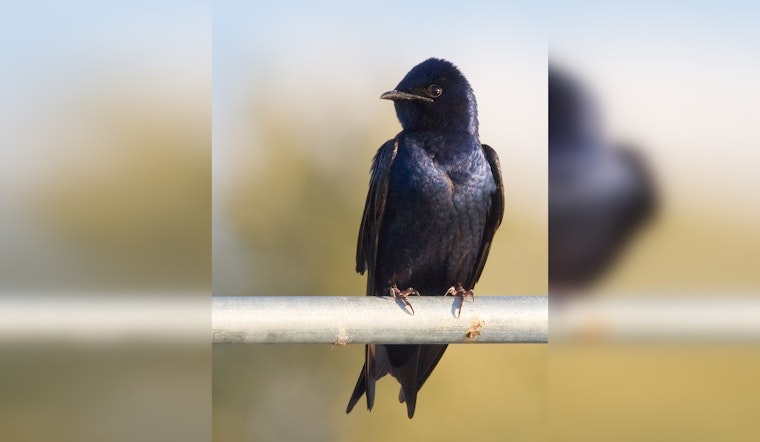
As the sun sets over Round Rock near Austin, a natural phenomenon paints the sky, not with colors but with the darting, acrobatic flight of Purple Martins, North America's largest species of swallow. Local and visiting bird enthusiasts have a limited window to observe these creatures before they embark on a migration that stretches deep into the verdant heart of Brazil. According to KXAN, thousands of these birds can be viewed in the 2600 block of La Frontera Blvd, offering a spectacle as they capture their food in mid-air ballet.
Shelia Hargis, a volunteer with Travis County Audubon since 1997, paints the scene with her observations stating, "These are birds that are very acrobatic in the air, they can fly really well" and adding the collective advantage for the birds against predators when they roost together, the sheer numbers making each individual less likely to be picked off by a hawk or owl. Despite the grandeur, Hargis humorously warns spectators that, "with 100,000 birds circling above you, things fall from the sky from those birds," which she assures, though potentially messy, is considered good luck - according to a KXAN report.
Simultaneously, the Austin American Statesman details the deep commitment of the Travis Audubon volunteers, who wake early to search beneath the roosting sites for injured or perished birds, the condition of these birds serving as a testament to the fragility inherent in this stage of their life cycle, only one in four juveniles make it to adulthood, the risks of urban life clashing with the ancient rhythms of nature’s design.
The gatherings, which peak in numbers in July and August, are a prelude to the Martins' impressive migration, an event that prompts enthusiasts like David Cook and Adam Baratz to point their lenses skyward, hoping to capture the essence of this swift, swirling dance before it dissipates like a whisper on the wind, the birds sweeping lower as night deepens until they finally settle into the trees that serve as their temporary abode.
These twilight congregations, where females don the garb of gray beneath with dark feathers atop and males wear the dark purple-blue that sometimes takes three years to fully manifest, draw crowds who hope to bear witness to the grace of these avians - a nod to the power and simplicity inherent in the natural world, despite the grim reminder that casualties punctuate the spectacle, the result of collisions with the human-made structures that fringe their roosting sites, as documented by the Travis Audubon volunteers.
For those wishing to partake in this communal experience, join the upcoming watch parties hosted by Travis County Audubon on July 26 and 27 from 8:00 to 9:00 p.m. Attendees are recommended to bring necessities such as water, binoculars, a chair, and perhaps a hat or an umbrella for protection from the aerial bombardments, a side effect of marveling at this natural assembly - a warning underscored by KXAN reports.




