

























































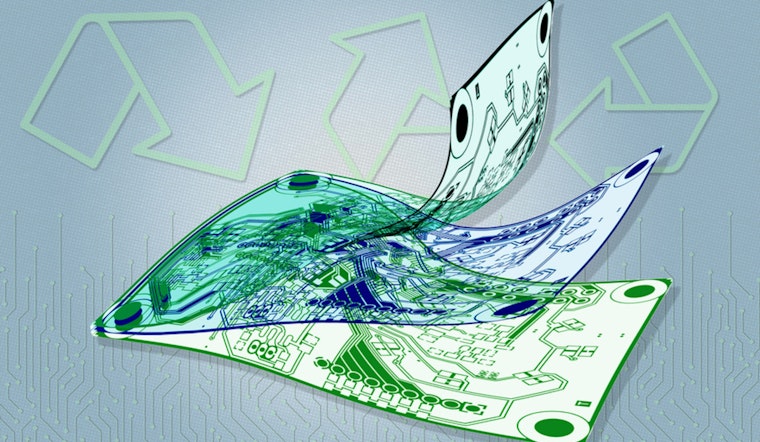
The escalating crisis of electronic waste, better known as e-waste, looms over our modern digitized society with dire environmental implications. As the digital wave continues to swell, a collaboration between researchers at MIT, the University of Utah, and tech giant Meta promises a potential salve for this acute challenge. Their innovation, reported in the journal RSC: Applied Polymers, unveils a flexible substrate material designed to revolutionize electronic recycling and scale up the production of intricate multilayered circuits often used in devices.
According to MIT News, MIT Assistant Professor in the Department of Materials Science and Engineering Thomas J. Wallin emphasized the urgency of tackling e-waste amidst the explosive growth of the internet of things and global technological advancement. The new material comes as an alternative to the widely used, yet environmentally resilient, Kapton—a polymer chosen for its superior thermal and insulating properties. Despite its common use in electronics, reprocessing Kapton has remained a challenge due to its resistance to melting or dissolving.
Professor Chen Wang from the University of Utah illuminated the issue, explaining that traditional Kapton's stubbornness is beneficial for applications requiring high heat tolerance, like aerospace, but has been static in development for several decades. The alternative material, resembling light-cured polymers, boasts the ability to harden swiftly at room temperatures, catalyzing the manufacturing process significantly.
The recycling advantage of the new substrate is noteworthy. As Professor Wang described, "We designed the polymer with ester groups in the backbone," unlike traditional Kapton, as reported by MIT News. These ester groups allow for a smooth disintegration by a mild alcohol and catalyst solution, thus separating the substrate and leaving precious metals and microchips unscathed for reuse. The University of Utah has reportedly co-founded a company to bring this important technology to market, suggesting both an environmental and economic incentive for innovation in this space.
The team behind this breakthrough comprises not just Wallin and Wang, but also Caleb Reese and Grant Musgrave from the University of Utah, and Jenn Wong, Wenyang Pan, John Uehlin, Mason Zadan, and Omar Awartani from Meta's Reality Labs. The project has drawn support from the startup fund at the Price College of Engineering at the University of Utah, highlighting the collaborative spirit fueling the endeavor to mitigate e-waste. If this new substrate material delivers on its promise, it could herald a significant step towards sustainable electronics manufacturing and recycling—perhaps even making a dent in the e-waste crisis that grows with every new gadget we bring into our lives.





