

























































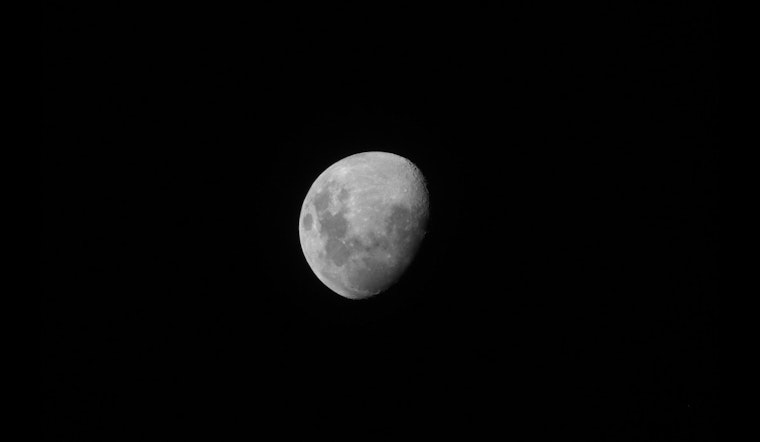
The moon's delicate atmosphere, long a subject of inquiry, has been a primary focus for scientists striving to understand its formation and sustenance. Now, research spearheaded by the Massachusetts Institute of Technology (MIT) and the University of Chicago has offered notable insights into this exospheric phenomenon. A recent study, published in Science Advances, introduces evidence supporting "impact vaporization" as the leading force behind the moon's atmosphere.
By analyzing lunar soil, which was meticulously collected by Apollo astronauts, scientists have concluded that the moon's surface endured persistent meteorite impacts over its 4.5-billion-year history. These events have vaporized specific elements, casting particles into a thin layer above the moon's crust. "We give a definitive answer that meteorite impact vaporization is the dominant process that creates the lunar atmosphere," Nicole Nie, an assistant professor at MIT's Department of Earth, Atmospheric and Planetary Sciences, told MIT News. The research posits these impacts liberate atoms, some drifting away into space, others lingering to form the moon's exosphere.
NASA's Lunar Atmosphere and Dust Environment Explorer (LADEE), dispatched in 2013, aimed to disentangle the dual hypothesis that impact vaporization and solar wind-induced "ion sputtering" both contribute to the atmospheric composition. Despite initially inconclusive results, the mission served to sharpen the parameters of the ensuing investigation.
Subsequent analysis on Earth, facilitated by isolating potassium and rubidium isotopes from the lunar samples, revealed a prevalence of heavier isotopes remaining in the soil, indicating a distinct isotopic distribution resultant from meteorite activity. "From our study, we now can quantify the role of both processes, to say that the relative contribution of impact vaporization versus ion sputtering is about 70:30 or larger," Nie explained in a statement procured by MIT News. This essentially attributes approximately 70 percent of the lunar atmosphere to impacts while giving less sway to the solar wind's role.
The significance of this research extends beyond the understanding of the moon's atmospheric history. According to Justin Hu, a postdoctoral scholar at Cambridge University who specializes in lunar soils, "The discovery of such a subtle effect is remarkable, thanks to the innovative idea of combining potassium and rubidium isotope measurements along with careful, quantitative modeling." Hu, who was not involved in the study, emphasized the potential implications for understanding other celestial bodies in the solar system.
These findings elucidate the long-standing question regarding the moon's exosphere while simultaneously underscoring the importance of sample-return missions in planetary science. "It's important for us to bring samples back from the moon and other planetary bodies, so we can draw clearer pictures of the solar system's formation and evolution," Nie articulated, highlighting the intrinsic value of research grounded in physical evidence. The work, supported in part by NASA and the National Science Foundation, therefore, reinforces the philosophy that tangible samples are indispensable for advancing our comprehension of planetary processes and, by extension, our origins and place within the cosmos.



