

























































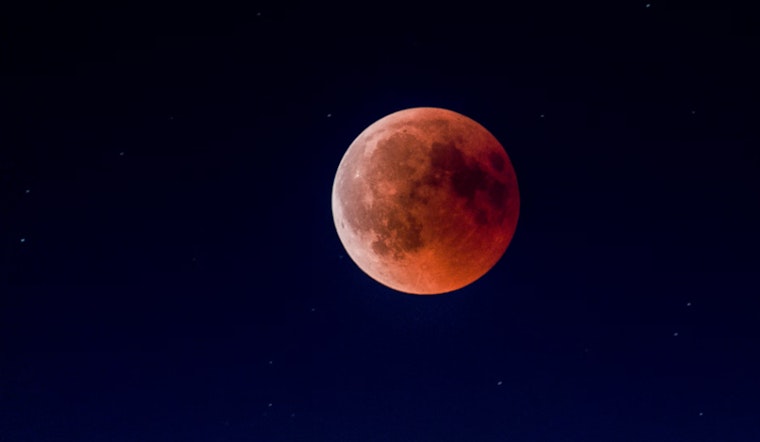
Stargazers in Arizona are set for a celestial treat as a supermoon coincides with a partial lunar eclipse tomorrow. The supermoon is the year's second such event, when the moon appears larger and brighter than normal, as Phoenix New Times reported. In a bit of cosmic choreography, a partial lunar eclipse will darken a fraction of the moon's surface, visible across North and South America, as well as in Africa and Europe on Wednesday morning.
Around the Arizona skies, the moon is scheduled to rise at 6:30 p.m. tomorrow, eventually peaking early Wednesday at 12:34 a.m., according to Time and Date. Observers should look toward the eastern sky to catch the rising supermoon. The Earth sandwiched between the sun and the moon creates the partial lunar eclipse when only part of the moon traverses through Earth's umbra, starting at 7:13 p.m. and climaxing at 7:44 p.m. as mentioned by KTSM.
Supermoons are not only a feast for the eyes due to their size—about 14% bigger—but also shine about 30% brighter. Tuesday night's forecast points towards clear skies, providing a prime viewing experience with minimal to no cloud cover. For an up-close look at the moon's features, binoculars or a telescope might be useful, though the supermoon will be hard to miss with 99.9% illumination, even to the naked eye.
Valerie Rapson, an astronomer at the State University of New York at Oneonta, shared with KTSM that "A little bit of the sun's light is being blocked so the moon will be slightly dimmer" during the eclipse. Those interested in observing the simile eclipse's subtle changes might consider spending a few hours outside or taking intermittent glances throughout the evening. No special eye protection is necessary to view these phenomena.
For those seeking an even more dramatic lunar event, a total eclipse is earmarked for March 13, with the moon becoming entirely shrouded by Earth's shadow and taking on a reddish hue due to scattered sunlight filtering through the Earth's atmosphere.



