

























































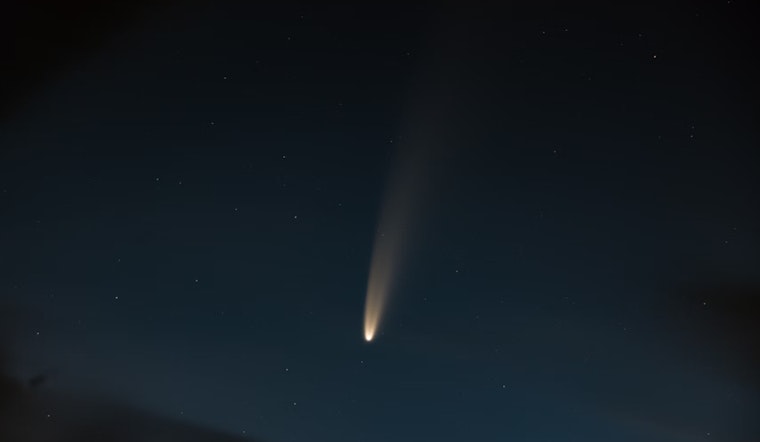
As Comet Tsuchinshan–ATLAS (C/2023 A3) carves its celestial path close to Earth, astronomers and amateurs alike are turning their eyes—and lenses—skyward. Discovered in early 2023, this cosmic visitor is currently staging what could be a stellar performance, with predictions suggesting it might just be viewable to the naked eye. The hype is particularly high following its brush with the sun, which ignited its icy body into a brighter glow, and has given way to anticipation that it could become a standout spectacle in the autumn sky.
Residents of Arizona are especially poised for a thrilling show, according to the Phoenix New Times, the comet is visible low on the eastern horizon during the early morning hours, and while the window for catching a glimpse of this celestial wanderer is fleeting, it could brighten significantly enough to be seen without the aid of binoculars or telescope—though experts, including Claude Hayes of the East Valley Astronomy Club, recommend having them on hand just in case, as comets' brightness can be unpredictable, and for now the chances are "slim" it can be seen with the naked eye. Coinciding with its perihelion, or closest approach to the sun, spotted at a distance not too different from Mercury's average orbital separation, the comet's visibility is progressively improving for those in the Northern Hemisphere too.
Observers keen on catching sight of Comet Tsuchinshan–ATLAS might set their alarms for early morning hours around 30 minutes before sunrise for current viewing opportunities, but starting on October 12, it transitions to an evening comet, potentially making it a more accessible sight around sunset, as mentioned by Phoenix New Times. When it comes to locating it, it's eastern or southeastern skies a few degrees above the horizon where star-gazers should direct their attention.
Nevertheless, the challenge of spotting Tsuchinshan–ATLAS is amplified by its low altitude which drags it through Earth's atmospheric haze, an unwelcomed filter that tends to dim celestial objects—here, binoculars are indispensable for cutting through this visual static, as they allow for a closer, sharper view that could make all the difference in identifying the comet. One's best bet could be on the morning of September 30, with a waning crescent moon to serve as a celestial marker, 13 degrees above the eastern horizon one hour before sunrise, the comet should sit 15 degrees to the lower right of the moon, as Space.com advises.
Digital aids are also at skywatchers' disposal, with apps like SkyGuide and SkySafari (the latter requiring a subscription) guiding enthusiasts to the faint celestial object. On the question of Earth safety, it’s been established with certainty that the comet poses no risk of impact, according to both of the aforementioned sources, astronomers have been watching closely and assure us that Comet Tsuchinshan–ATLAS will dance by at a comfortable 70 million miles (or 113 million kilometers) distance at its nearest point on October 12 and 13.



