

























































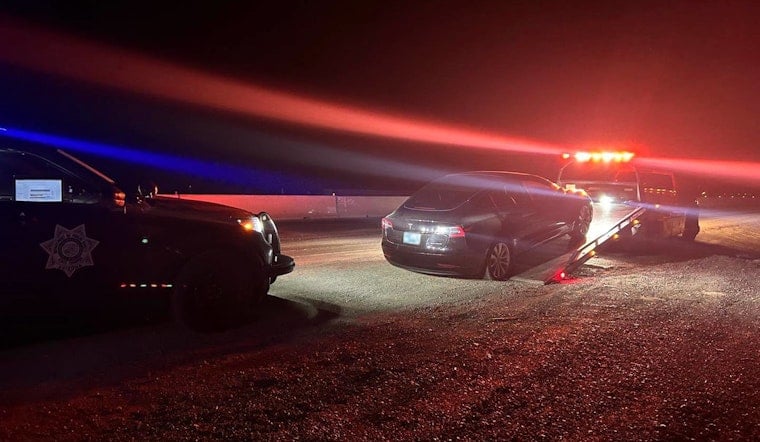
An Arizona trooper clocked a Tesla driver going 78 mph through an active 55-mph construction zone on Interstate 10 near the Sacaton rest area early Thursday, and the man told police the car was driving itself. He was arrested on DUI-related charges after failing multiple field sobriety tests, and troopers say he admitted to drinking a couple of beers before getting behind the wheel.
According to FOX 10 Phoenix, the driver was heading home from Tucson when Arizona Highway Patrol recorded the lidar speed reading and pulled him over near the work zone, where road crews were present at the time. Troopers say the Tesla had drifted onto the shoulder of I-10 at nearly 80 mph before the stop, and the man later told officers he needed to reach a church event the next morning for an interview to become a church musician. He missed the audition. The Arizona Department of Public Safety Highway Patrol, which provided the details for the report, said the driver showed signs and symptoms of impairment and refused a preliminary breath test at the scene.
Two Handguns Found Within Reach
A search of the vehicle turned up two handguns within easy reach of the driver's seat, though troopers did not identify the man publicly. Under Arizona Revised Statutes § 13-3102(A)(1)(b), adults 21 and older may legally carry a concealed firearm in a vehicle without a permit, according to GunMapUSA, but drivers must answer truthfully if an officer asks whether they are armed. It remains unclear whether the weapons will factor into any additional charges.
Troopers towed the Tesla and booked the driver into jail on DUI-related charges after he refused the breath test. That refusal carries its own legal weight: Arizona's implied consent law, outlined at A.R.S. § 28-1321, means any driver on state roads automatically consents to chemical testing, and refusing a post-arrest breath, blood, or urine sample triggers an automatic 12-month license suspension for a first refusal, according to the Rosenstein Law Group. The law also allows officers to seek a search warrant for a blood draw even after a roadside refusal, though it is not yet known whether investigators pursued one or what any resulting blood-alcohol results showed.
A Dangerous Stretch Under Construction
The arrest happened within the I-10 Wild Horse Pass Corridor, a 26-mile stretch between south Phoenix and Casa Grande undergoing a major widening project that includes a $71.2 million replacement and expansion of the I-10 bridges over the Gila River near Sacaton, running from mid-2024 into late 2026, per KTAR News. Speeding through a designated work zone in Arizona doubles civil traffic fines under A.R.S. § 28-710 regardless of whether crews are physically on site, according to the Sargon Law Group. Preliminary Arizona Department of Transportation data found that work zone-related crashes caused 16 deaths and 36 serious injuries statewide in 2025, underscoring why officials treat corridors like this one as especially hazardous.
A broader study of federal crash data from 2020 through 2024 ranked Arizona fifth nationally in fatal construction zone crashes relative to the size of its construction workforce, averaging more than 21 fatal work-zone crashes annually, according to The Gila Herald. The Arizona Department of Public Safety said self-driving technology does not eliminate the need for driver alertness, adding that drivers need to be ready to intervene at any moment.
Self-Driving Claim Meets Federal Standards
The driver's claim that the Tesla was in self-driving mode runs up against how federal regulators classify the technology. Society of Automotive Engineers standards recognized by the National Highway Traffic Safety Administration define Tesla's Autopilot and Full Self-Driving features as Level 2 Advanced Driver Assistance Systems, meaning they require full human oversight at all times, according to Deandra Grant Law. Tesla itself issued a recall in April 2023 covering more than 360,000 vehicles equipped with Full Self-Driving Beta after federal officials raised concerns the software behaved unpredictably in complex road situations, per regulatory filings with NHTSA. Whether the vehicle's event data recorder confirms Autopilot or FSD was actually engaged during the stop has not been disclosed.
If convicted of a standard first-offense DUI, the driver would face penalties under Arizona Revised Statutes § 28-1381, classified as a Class 1 misdemeanor carrying a minimum of 10 consecutive days in jail, more than $1,250 in fines, a 90-day license suspension, and mandatory installation of an ignition interlock device, according to Oliverson Law. The Arizona Department of Public Safety has stepped up enforcement on highways like this one after statewide traffic fatalities rose 62% between 2014 and 2024, launching a high-visibility campaign under the slogan “Fast today, fined tomorrow.”
The case echoes a similar incident Hoodline reported on a slumped-over Vacaville driver caught in a moving Tesla using driver-assistance features, another case where law enforcement stressed that human drivers remain legally responsible no matter what a vehicle's software is doing. As in that case, Arizona authorities say the technology in the driver's seat does not change who is accountable behind the wheel.





