

























































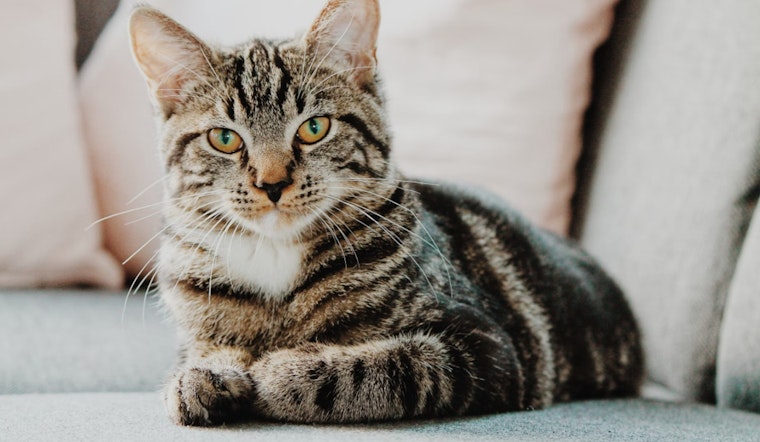
Harvard's love affair with its feline residents took a scientific twist last Saturday when evolutionary biologist Jonathan Losos shared his insights on why cats meow at humans, a subject explored in his new book "The Cat’s Meow: How Cats Evolved from the Savanna to Your Sofa." Speaking at the Harvard Museum of Natural History, Losos, who once limited his expertise to the behavior of lizards, disclosed fresh findings that domesticate felines have honed their meows over generations to become more appealing—and manipulative—to human ears.
Losos' statement countered the assumption that cats meow as a friendly salute to humans. Instead, research showcased that domestic cats have adapted their vocalizations to communicate more effectively with their human companions. According to an article published in a Harvard Gazette, Losos explained, "The domestic cat is much more pleasant to our ears, higher pitched. What that suggests is that during domestication cats evolved a difference in their meow that is more appealing to us — and lets them manipulate us more."
The discussion, which also touched on the broader ways cats communicate with both humans and each other, cited research comparing domestic cat sounds to those of larger felines from the Pretoria Zoo in South Africa. This research, involving recordings by Cornell University graduate student Nicholas Nicastro, demonstrates the evolutionary journey of the cat's meow from an urgent demand in the wild to its current higher-pitched, human-friendly form in our homes.
Beyond the vocalization aspects, Losos talked about non-verbal cues in cats, such as tail movements indicating their openness to social interaction. Mirroring some larger species like lions that signal friendliness with raised tails, domestic cats also exhibit similar patterns, an evolution that seems to fortify the bond between cats and their owners. However, one major distinction between wild and domestic felines is that lions hunt cooperatively, whereas domestic cats typically hunt alone—a fact that urban cat colonies and house cats alike can attest to.
Losos' investigation into feline evolution also digs deep into historical timelines, providing backgrounds on the emergence of domestic cats alongside the early advent of agriculture. The reciprocal relationship between humans and cats likely began when early farmers appreciated the rodent-hunting prowess of wild cats and offered them shelter and sustenance, leading to the gradual domestication of the species. Referencing genetic studies that link our present-day house cats to North African wild cats, the book unfolds a narrative that aligns with this theory.
The globe-trotting adventure of domestic cats from their origin lands to virtually every corner of the world except Antarctica, was facilitated by human civilization—evidently by Norsemen as well. Losos highlighted DNA evidence from a cat in a Viking burial site that bears striking similarity to that of ancient Egyptian cats. This suggests that just as these seafaring explorers expanded their territory, they also spread the domestic cat lineage across continents.
With only 75 species of domestic cats identified as opposed to at least 200 breeds of dogs, Losos suggested that in terms of diversity, our feline friends still have a lot of ground to cover. Yet, their pervasive influence, as both a factor in historical development and an object of contemporary study, serves as a poignant reminder of the cat's enduring appeal and its adaptive survival alongside humans.





