

























































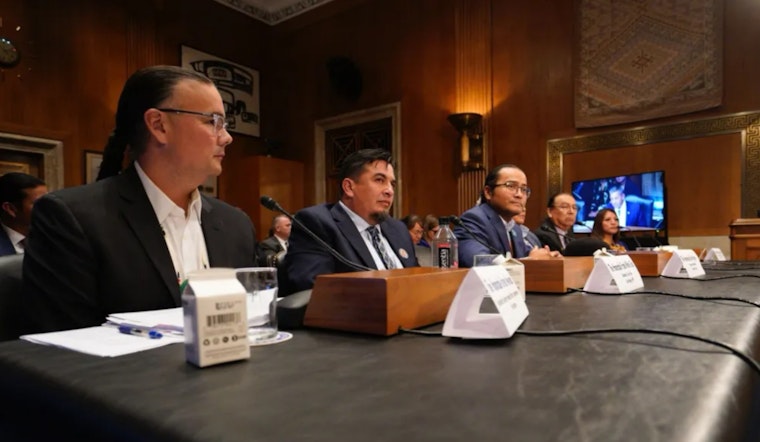
Navajo Nation President Buu Nygren took a pivotal stand before the U.S. Senate Indian Affairs Committee, explaining how two vital water rights settlements currently under Congressional consideration could drastically change the quality of life for thousands of Navajos. President Nygren shared his personal connection to the issue, stating, "Roughly a third of the Navajo Nation households lack running water, and that is how I grew up." He underscored the urgency for "Congress must act to end the water crisis on the Navajo Nation" in his testimony, as documented by the Office of the President and Vice President of the Navajo Nation.
The settlements in question, known as the Northeastern Arizona Indian Water Rights Settlement Act, S. 4633, and the Rio San José Water Rights Settlement Agreement Act, S. 4998, aim to reduce the burden on Navajo residents who endure expensive water hauling across challenging terrains. Currently, Navajos pay an average of $133 per thousand gallons for water, which President Nygren highlighted as one of most expensive in the country. Without these settlements, as President Nygren told Navajo Nation, the expensive and laborious task of "hauling water is incredibly expensive," continues to plague his people.
Assistant Secretary for Indian Affairs Bryan Newland confirmed the Department of the Interior's support for both pieces of legislation. Senator Ben Ray Luján, a proponent of both bills, sought clarity on how the settlements would benefit the Navajo among others, questioning, "What would resolving the water rights mean for the three tribes (Navajo, Hopi, San Juan southern Paiute) and for the United States as a trustee?" In response, Newland responded affirmatively, explaining how the settlements would bring essential water to those in need and alleviate longstanding water disputes, according to the Office of the President and Vice President of the Navajo Nation.
In solidarity with President Nygren, Hopi Tribal Chairman Timothy Nuvangyaoma and San Juan Southern Paiute Tribal Vice Chairman Johnny Lehi, Jr., testified on the far-reaching effects of the Northeastern Arizona Indian Water Rights Settlement Act. Vice Chairman Lehi noted, "It is a resolution to several decades of living as strangers in our own homeland," stressing the importance of establishing a reservation for the Paiutes. Chairman Nuvangyaoma echoed these sentiments, pointing out the necessity of the settlement for the Hopi tribe to secure a sustainable water supply, as testified on the Navajo Nation's official platform.
Addressing the Rio San José Water Rights Settlement Agreement, President Nygren highlighted the potential for S. 4998 to resolve claims in New Mexico, "provides a path forward that will protect the flow that remains in the Rio San José and provide the Navajo Nation with funding that would enable us to import water to serve Navajo chapters in the Rio San José and Rio Puerco Basins," as per his written testimony on the Navajo Nation website. He passionately connected the issue to the Navajo culture, stating, "Tó éí iiná até, (with water, there is life), and it is elemental to Hózhóogo Oodááł (the Navajo Way of Life)."
These settlements stand as a beacon of hope, not merely regulations in legal text, but as vital lifelines that promise to restore balance and provide essential resources to the Navajo Nation. Once ratified by Congress, President Nygren expressed confidence that decades of costly litigation will be put to rest, and certainty in water usage will be assured, thus benefiting not only the tribes but all parties involved in the Colorado River Basin.





