

























































In the United States, buildings are a significant source of carbon emissions, mainly due to energy loss through their envelopes — the protective outer shell consisting of the roof, walls, windows, and doors. Addressing this challenge, mechanical engineer Bryan Maldonado of the Department of Energy's Oak Ridge National Laboratory (ORNL) proposes a strategy to fast-track energy efficiency improvements in building envelopes, specifically targeting the vast inventory of pre-1980 structures that lack adequate thermal insulation, reported ORNL.
Improving older buildings has mostly focused on internal aspects like lighting or air conditioning systems, however, more than half of residential constructions in the U.S. still have minimal to no insulation in their exterior walls or envelopes. "One way to address this is by installing, or retrofitting, prefabricated panels with lower-carbon embodied materials and greater efficiency over the existing envelope," Maldonado commented, highlighting the potential for significant environmental benefits. The Department of Energy aspires to curtail greenhouse gases (GHGs) from buildings by 65% by 2035, and 90% by 2050, aiming for equitable benefits across communities.
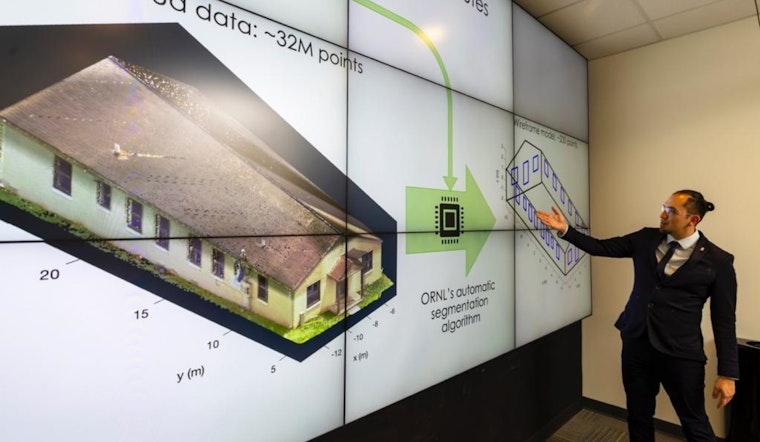
Maldonado has pursued using automation and machine learning to improve the building-envelope retrofit process and has developed the PIPE or Pipeline for Affordable, energy-efficient, and Time-saving Housing retrofits — anticipated to trim the retrofit process' time investment by a factor of five. The groundbreaking approach includes a real-time building evaluator tool that contrasts the positioning of prefabricated panels during installation with a digital twin of the building, formulated with exceptional precision using a 3D scanner, according to a statement obtained by ORNL.
The next steps for Maldonado's vision involve creating a one-stop software solution to supervise this process, from monitoring to optimization, finalized by the use of a slim, automated robotic crane for retrofitting high rises. The lean design of such technology could revolutionize construction sites, particularly in congested urban areas such as New York, "It can be automated using computer controls, and with the evaluator tool's precise measurements, it eliminates errors, decreases costs and does so in a safe manner," Maldonado explained.
Beyond his research strides, Maldonado devotes himself to fostering the next generation of STEM professionals. He's currently the vice president of ORNL's Hispanic and Latino Organization for Leadership and Awareness (HOLA) and has been recognized for his mentorship. His story, from an engineering enthusiast inspired by Formula One racing to an innovator in energy research, underscores his commitment to impacting society far beyond his native land, Ecuador. Alluding to his past experiences with international math competitions and his role as a mentor, he said, "Mentoring is important, because that’s why I’m here, because others showed me how I could make an impact beyond Ecuador." For detailed insights into Maldonado's pathways and endeavors, visit ORNL.



