

























































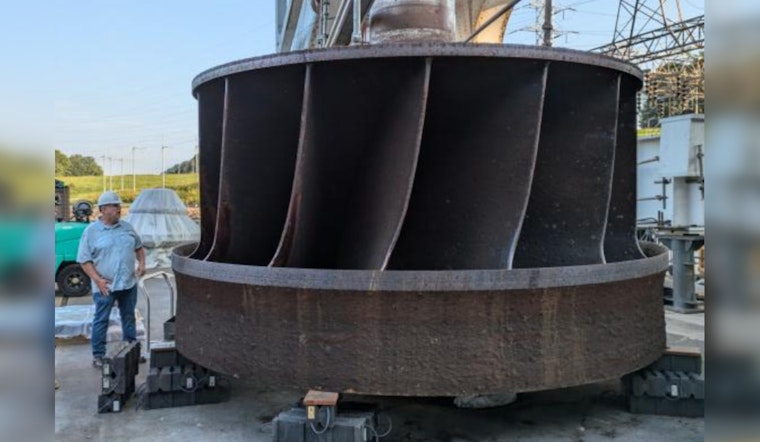
A new manufacturing initiative spearheaded by the Oak Ridge National Laboratory (ORNL) is set to rapidly produce large metal components crucial for clean energy, particularly in the hydropower sector. Funded by a $15 million grant from the Department of Energy (DOE), the project aims to bring back critical manufacturing technologies to the United States, potentially shortening the production time for hydropower turbine parts from 18 months to substantially less, according to the lab's experts.
The program, known as Rapid Research on Universal Near Net Shape Fabrication Strategies for Expedited Runner Systems or Rapid RUNNERS, seeks to efficiently create massive turbine runners that are integral to converting water pressure and movement into electrical energy. Typically, the wait for these components can stretch over years, leading facilities to lose both time and the ability to generate renewable electricity. The use of additive manufacturing, commonly known as 3D printing, will allow to more quickly produce parts that are close to their final form, a method termed as near-net-shape, as revealed by an ORNL announcement.
Adam Stevens, an R&D staff member at ORNL and the technical lead for the project, explained the significant impact this could have on the industry, stating to ORNL, "This has the potential to transform forging and casting of large-scale metal components." Stevens further detailed that this innovation could address the gap in the domestic industrial base for such large parts, effectively enhancing the resilience and sustainability of renewable energy production across the nation.
As part of this approach, robotic welders will be utilized to deposit metal layer by layer, forming the desired geometry with high precision. The subsequent finishing touches use traditional machining techniques, notably reducing waste and curbing the downtime usually experienced. According to Brian Post and Jay Tiley, project principal investigators from ORNL, the first runners made with this method will be tested for potential installation in the Tennessee Valley Authority’s (TVA) dams, one of which may see use in the Ocoee Dam in Parksville, Tennessee. Joe Hoagland, TVA's vice president of innovation and research, praised the innovative nature of the program, "This program offers an innovative way for us to fulfill TVA’s mission summarized by three ‘E’s: for Energy, it improves reliability, for the Environment, it maximizes renewable energy produced, and for Economic development, it brings great jobs back to the U.S."
The integration of software and robotics is key to this project, with the creation of a system where robots, each designated a specific function such as welding or grinding, all converge to manufacture these large components. This not only streamlines the process but also frees up workers for different tasks within the foundries and fabrication facilities. Furthermore, as Curt Jawdy, head of R&D at TVA, said to ORNL, "You can do things with additive manufacturing that you can't do otherwise. There are shapes you can make that you would not be able to make otherwise, and you can combine materials."
By the project's conclusion, after the three-year funding period, ORNL anticipates the creation of a novel distributed hybrid-manufacturing platform applicable across different industrial sectors. The initiative involves numerous partners, such as Huntington Ingalls-Newport News Shipbuilding and the Electric Power Research Institute, all collaborating with ORNL to develop the necessary tools and strategies for production. This new system could revolutionize how we think about manufacturing large-scale metal components stateside, boosting both the clean energy sector and potentially defense, shipbuilding, and other industries requiring substantial metal parts.



