

























































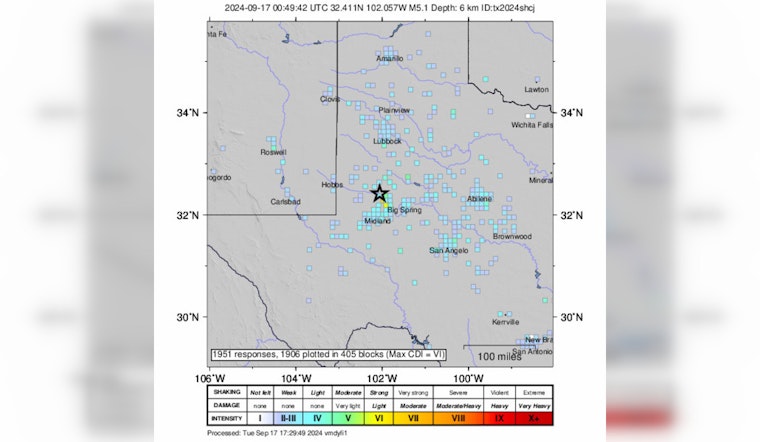
West Texans experienced one of the state's rarest events Monday evening—a magnitude 5.1 earthquake that shook foundations and rattled nerves. The tremor, centered near Ackerly, was felt by residents throughout a wide swath, including as far as Austin and Fort Worth. According to the KXAN, the quake's epicenter was roughly 20 miles north of Midland, placing it among the most significant seismic activities to hit the state.
As data from the U.S. Geological Survey was quickly gathered, more than 1,400 reports of shaking came flooding in post-quake. The impact zone stretched over a great distance, with reports emerging from cities up to 322 miles from the epicenter. Per an analysis by NBC News, earthquakes east of the Rocky Mountains can be felt over longer distances and occasionally cause more damage than their counterparts in the West for equivalent magnitudes. It's also detailed that these tremors, especially when centered in populated areas, are not just felt widely but could also potentially create extensive damage.
This particular earthquake, while strong, fortunately, did not initially result in any reports of injuries. Texas has seen only seven previous earthquakes measuring 5.0 magnitude or higher, with Monday's event becoming the eighth, as pointed out by KXAN. The strongest among these struck Valentine in 1931, with a magnitude of 5.8.
While the region around Ackerly, which lies about 60 miles north of Midland, is known for fracking—a process injecting water into the ground at high pressure to crack rocks and extract oil—the connection between such human activities and seismic events remains a subject of debate. The U.S. Geological Survey has acknowledged that "There is evidence that some central and eastern North America earthquakes have been triggered or caused by human activities that have altered the stress conditions in earth's crust sufficiently to induce faulting." However, they have yet to conclusively link fracking to the recent quake. Still, the agency asserts that while fracking has been related to a small fraction of earthquakes, more are attributable to wastewater disposal, as per NBC News.
The aftershock of the event was metaphorically ripple through communities concerned about the potential for future quakes. As local and national agencies continue to monitor seismic activities, questions about the role human intervention plays in such natural disasters will undoubtedly remain at the forefront of conversations in regions susceptible to such earth-shaking events.





