

























































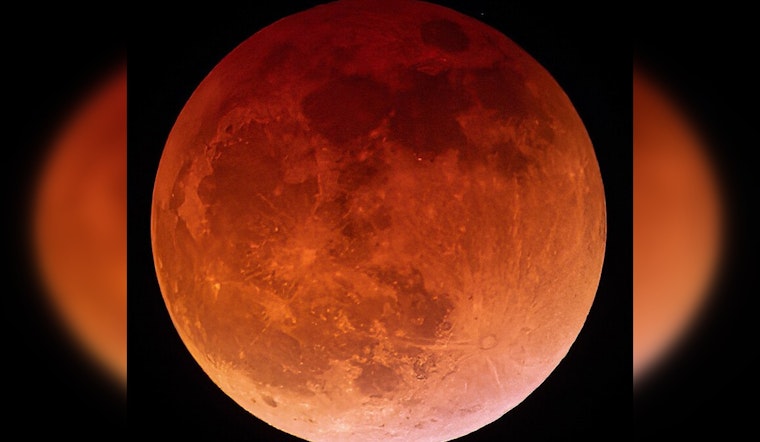
Stargazers are in for a treat this Tuesday night with September's Harvest Moon aligning celestial occurrences to ignite interest in the night sky. September 17 will see not only a full moon but also a partial lunar eclipse and the bonus of a supermoon. As reported by KXAN, the unique triple showcase starts with the partial eclipse beginning just after sunset, where the Earth will cast a shadow on a part of the moon, creating an awe-inspiring visual display.
The lunar event is special as it occurs conveniently close to the autumnal equinox set for September 22, thus earning the name Harvest Moon. Historically, this provided additional light for farmers to work late into the evening. The supermoon aspect means that the full moon will appear about 14% larger and 30% brighter in the sky, as it reaches its closest point in orbit to Earth, setting the stage to spectacularly showcase the cosmic dance. KXAN outlined that the eclipse will peak at 9:44 p.m., promising those looking upward a glimpse at a reddened lunar facade.
Those interested in catching sight of the lunar eclipse won't need any special equipment. The event is easily visible to the naked eye, with the initial stages starting at 7:41 p.m., peaking at 9:44 p.m., and concluding at 11:47 p.m. Observers can simply step outside and look to the heavens to partake in the lunar showcase. According to KXAN, the next occurrence visible from North America won't be until March 13, 2025, making this event all the more significant.
Adding more to the interest, KVUE notes that this supermoon is nearly 3,000 miles closer to Earth than the one in August, with the moon reaching a striking proximity to our planet. This slight, yet powerful shift subtly intensifies the Earth's tides. If you're planning to watch, remember to catch the event beginning at 8:41 p.m. EDT, when the moon enters Earth's partial shadow, and particularly at 10:13 p.m. EDT, when it moves into the full shadow, only to emerge partially bitten at its peak at 10:44 p.m. EDT.
The Harvest Moon is a part of our collective history, serving farmers before the advent of electricity by allowing them to continue the hard work by moonlight. This year's full moon will offer not only a historical nod to our agricultural foundation but also a captivating display of astronomy's wonders in real time. Those seeking a view of the Harvest Moon in all its magnificence should mark their calendars and afford themselves the simple pleasure of gazing up into the autumn night.





_(cropped).jpg)