

























































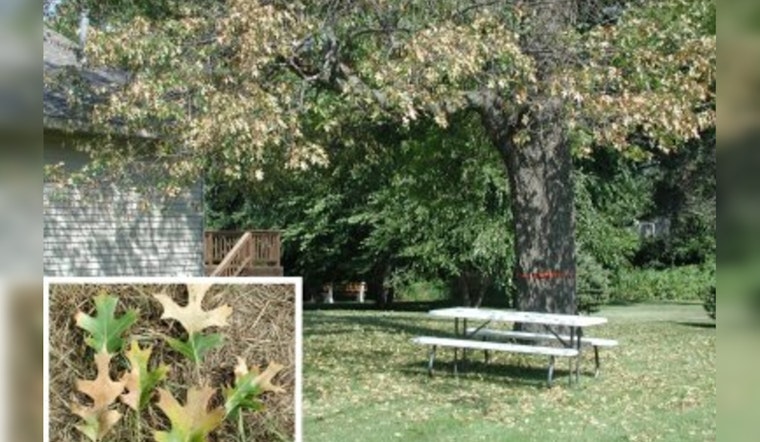
In a significant step towards protecting North American oak trees, a team from the University of Minnesota has come up with a quick and reliable technique for diagnosing oak wilt, the infection decimating this robust species. Their work, rooted in solid science and backed by the Minnesota Invasive Terrestrial Plants and Pests Center, utilizes gold nanoparticles to pinpoint the pathogen within 30 minutes—a much-needed advancement to combat the disease spread in Minnesota and beyond, as reported by the University of Minnesota news release.
The research team incorporated these gold particles into a previously established method called the Loop-mediated isothermal amplification (LAMP) assay, a technique hailed for its rapid and cost-effective diagnostic potential. Despite being groundbreaking, this approach was put to rigorous tests demonstrating its high sensitivity and specificity when applied to both infected and healthy red oak samples, a detail which came directly from the researchers. Akli Zarouri of the College of Food, Agricultural, and Natural Resource Sciences emphasized the potential impact of their work, "This study introduces a novel approach that simplifies and speeds up the diagnosis of oak wilt, potentially transforming disease management practices for this serious threat to oak tree health in both natural and urban ecosystems in Minnesota."
The simplicity of the tool lies in its ability to show results visually: a red pellet forms in the presence of oak wilt's DNA, observable with the naked eye. This innovation not only holds promise for field application but also marks a possible watershed for plant pathology, as stated by Vinni Thekkudan Novi, a lead author on the project and a researcher at the USDA. "This LAMP assay, with its rapid processing and easy visualization, offers a powerful tool for field diagnosis of oak wilt, and holds potential for broader applications in plant pathology," Novi told the university news service. The assay's efficacy with crude DNA extracts from diseased wood further shortens and simplifies the diagnostic process.
Looking ahead, the team at the University of Minnesota plans to fine-tune the LAMP assay for real-world use; they intend to validate it under field conditions with larger sample sizes to mirror the diverse scenarios presented by oak wilt's spread, though the research thus far has shown a consistent rate of diagnostic accuracy and reliability which shines a hopeful light on the future use of this technology for land managers. Moreover, optimizing the assay for different environmental conditions will increase the tool's ease of use across varied settings—a step that could prove critical in containing and managing oak wilt. This research is supported by the USDA National Institute of Food and Agriculture and the Schwan Food Company Graduate Fellowship, alongside funding from the Minnesota Environment and Natural Resources Trust Fund as recommended by the Legislative-Citizen Commission on Minnesota Resources (LCCMR).
The College of Food, Agricultural and Natural Resource Sciences at the University of Minnesota takes pride in combining education and science to face the world's grand challenges head-on, offering a rich tapestry of experiential learning opportunities. Similarly, the Minnesota Invasive Terrestrial Plants and Pests Center stands as a unique institution dedicated to the study of invasive species prevention, detection, and control—work that not only benefits Minnesota but also provides insights on a global scale.





