

























































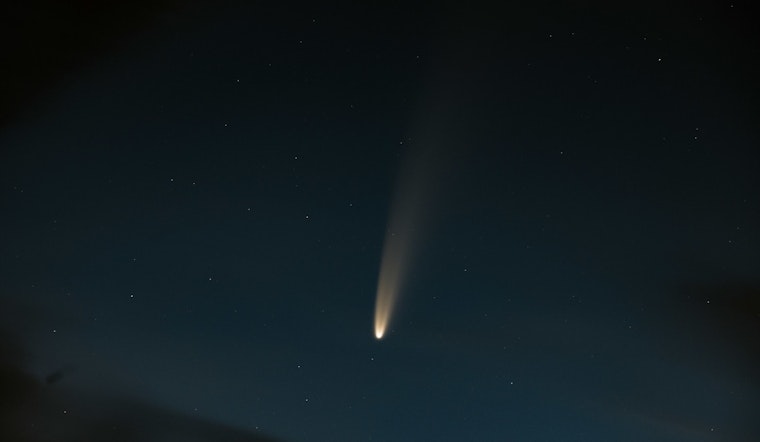
Last week, the skies enthralled with one of the most stunning natural phenomena on Earth, the Northern Lights, visible in places where they usually remain a legend. This week, however, those looking up from Arizona have another celestial event to spot. According to Phoenix New Times, the so-called "comet of the year," Comet C/2023 A3, or Tsuchinshan-ATLAS, will grace our skies just after sunset, inviting everyone to witness a cosmic occurrence that last paraded by Earth 80,000 years ago.
The comet, first spotted in 2023 by the Tsuchinshan Observatory and the ATLAS asteroid tracking system, has brought with it, not just an observable brilliance but a flood of interest from stargazers across Arizona. "Binoculars are your friend in this case, so use them," Claude Haynes of the East Valley Astronomy Club convincingly told Phoenix New Times. Comet A3 will be visible approximately 45 minutes after sunset in the western sky, best viewed between the constellations Sagittarius and Scorpio, about 10 degrees above the horizon.
For those seeking more detailed tracking, local astronomers recommend apps like SkyGuide and SkySafari to locate the comet. The comet's close proximity to Earth on October 12 and 13, about 70 million miles away, per Phoenix New Times, offers an unusual viewing opportunity that is not to be overshadowed by recent memories of the auroras.
While the aurora borealis, or Northern Lights, made an unexpected foray as far south as Arizona and Florida due to a significant geomagnetic storm that occurred on October 10, the phenomena aren't expected to repeat, as reported by Forbes. Instead, attention pivots to the night sky's latest offering, Comet A3. The comet, despite its distance from Earth, is deemed safe by astronomers who've been analyzing its orbit, and trajectory, assuring there is "zero chance" of an impact.
If one takes the opportunity to venture into the twilight afterglow today, or any day hence until the month's end, their patience could be rewarded by the sight of Comet A3 tailing across our celestial dome. For those with a penchant for the stars - or simply a curiosity that beckons - directing your gaze westward after sunset might just reveal the secrets of a visitor from the distant Oort Cloud.





