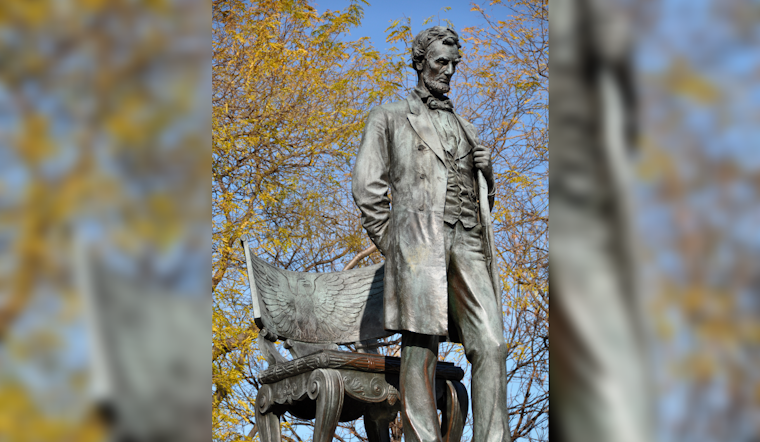
An Abraham Lincoln statue in Chicago's Lincoln Park was found splattered with red paint on Indigenous Peoples Day, marking the second such act of vandalism on the monument in as many years. According to Block Club Chicago, the statue on the 1700 block of North Stockton Drive had messages including "Lincoln was an executioner," "Land Back" and "May all empires fall from Turtle Island to Palestine" sprayed around its base. The phrase "Avenge the Dakota 38" was also visible, about Lincoln's controversial order for the execution of 38 Dakota men during the Dakota War of 1862.
The Chicago Police Department reported no injuries from the incident, and have yet to make any arrests. In a similar vein, last year the statue was defaced with analogous messages by a group self-described as “resistors of colonial violence,” a detail reported by Block Club Chicago. These acts of vandalism appear to coincide with Indigenous Peoples Day, a time that has seen a reckoning with historical figures and their legacies about native peoples.
Another statue, this one depicting a "Young Lincoln," located in Senn Park, also fell victim to vandalism in November 2022. CBS News Chicago notes that the Lincoln Park statue, situated near the Chicago History Museum, is no stranger to such incidents. The monument, celebrated for its artistry and historical significance, stands where it was erected in 1887—throughout the changing tides of social and political discourse on America's past.
Amid these events, President Joe Biden officially recognized Indigenous Peoples Day in 2021, an acknowledgment of the painful history of federal policies towards Native American communities. This designation came as a shift away from the prior Columbus Day, a day that has increasingly been scrutinized for its celebration of an explorer connected with violence against Indigenous peoples. Even as the legacies of these historical figures are debated and re-evaluated, the Standing Lincoln, hailed as "one of the 19th century’s greatest masterpieces of public art," now carries the marks of contemporary conflict, bearing witness to the nation's ongoing struggle to reconcile its history.