

























































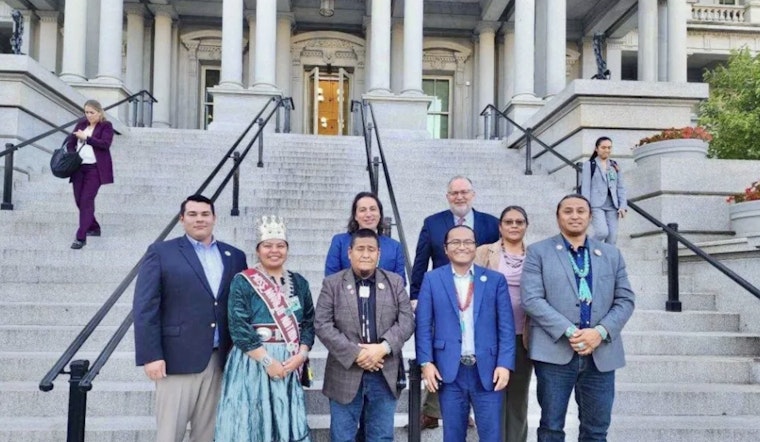
Navajo Nation President Buu Nygren and Land Commissioners Otto Tso and Casey Allen Johnson were in Washington on Monday to push for the appointment of a new commissioner for the beleaguered Office of Navajo and Hopi Indian Relocation (ONHIR), seeking to address a longstanding crisis caused by misguided and harmful relocation efforts, according to a statement from the Office of the President and Vice President of the Navajo Nation.
In a detailed 14-page letter to the White House, Navajo officials highlighted the ongoing struggles of displaced individuals, emphasizing the disconnect between their experiences and the Office of Navajo and Hopi Indian Relocation's repeated, and what the delegation deems erroneous, claims of readiness to close. They argue that this situation necessitates not only a leadership change but also a comprehensive reevaluation of the office's ability to meet its complex responsibilities. This issue has persisted for generations, resulting in profound social and cultural impacts beyond mere financial costs.
In their letter, Navajo leaders emphasize a painful history, noting that families continue to suffer from the repercussions of the 1974 Navajo-Hopi Relocation Act. They draw parallels to the internment of Japanese Americans during World War II and reference both their recent documentation and comments from figures like the late U.S. Senator John McCain, who recognized the profound failures of the Relocation Act, "The Navajos have lost, the Hopis have lost, and the attorneys have won," McCain told the Monitor in 1999, as reported by the Office of the President and Vice President of the Navajo Nation.
The requests presented at the White House were clear and urgent. They call for the immediate appointment of an ONHIR commissioner after nearly three decades of leadership vacancy, as well as support for legislative amendments to address systemic issues. Additionally, they seek the development of a comprehensive plan to transition ONHIR's functions in a manner that honors its original commitments. This is a call for action amid the ongoing impacts of past mistakes, including stories of broken families and communities, and homes that deteriorated as quickly as they were constructed.
Despite these ongoing challenges, the Navajo Nation remains committed to achieving justice and remediation for those affected. The recent meeting is viewed as a potential turning point in their fight to hold the federal government accountable for addressing a historical injustice that has left many in a state of displacement and despair, NNWO Director Justin Ahasteen said, “The consultation at the White House marks a pivotal moment in the Navajo Nation’s quest for justice,” in a statement obtained by the Office of the President and Vice President of the Navajo Nation.





