

























































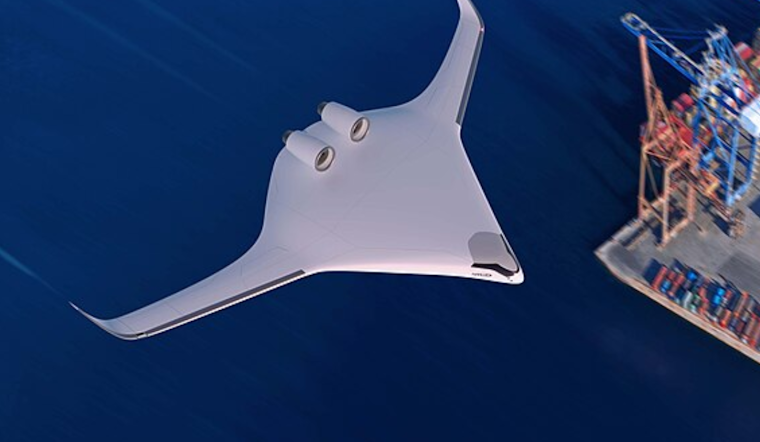
In an announcement that signals a significant shift for commercial aviation, San Diego's Natilus has revealed an aircraft design that it says would cut emissions in half. Named the Horizon, this blended-wing-body (BWB) aircraft is poised to address industry-wide sustainability concerns by promising to halve carbon emissions. As reported by the Times of San Diego, the Horizon can carry up to 200 passengers.
The Times of San Diego indicates that the aircraft will integrate seamlessly with current airport infrastructure, thanks to its conventional landing gear and fuselage. Notably, Aleksey Matyushev, CEO and co-founder of Natilus, underlined the demand for sustainably-driven progress in aviation, stating, "the commercial aviation industry is looking for real solutions to become more sustainable, more efficient, and more profitable." Matyushev explained, "The BWB design offers major advantages in fuel efficiency, payload capacity, and operational costs compared to the traditional tube-and-wing aircraft." The firm targets a market launch by the early 2030s to align with the aviation sector's 2050 net-zero emission goals.
Parallel to the traditional media announcement, Natilus took to LinkedIn to mark the world premiere of its Horizon aircraft, highlighting its credentials in the sustainability arena. Approximately 918 million metric tons of CO2 emissions attributed to the commercial aviation industry annually point to the necessity for a greener approach amidst the rising trends in air travel, with passenger numbers crossing the 4.5 billion threshold in 2024.
The LinkedIn post by Natilus emphasized that while adopting Sustainable Aviation Fuel (SAF) is growing, it currently accounts for only about 0.5% of global aviation fuel. Echoing the statements made to The Times of San Diego, the company expressed its commitment to shaping a sustainable future for aviation. "As the aviation industry seeks effective solutions to modernize fleets and enhance sustainability, our dedicated team has invested countless hours developing the HORIZON to be a real solution and to fit seamlessly into existing airport operations."
Natilus's foray into the passenger aircraft market with the Horizon comes as the company also works on an autonomous cargo aircraft called the Kona.
Editor's Note: This article has been updated to correct inaccuracies. Natilus has not yet developed a prototype for the Horizon, and the last name of the CEO and co-founder is Matyushev, not Matyushe.





