

























































Security training is stepping into the realm of virtual reality to enhance the safety of nuclear reactors. A team of researchers at the Department of Energy's Oak Ridge National Laboratory (ORNL) has tapped VR technology to closely observe and understand human behavior in high-security areas. The goal is to anticipate insider threats within nuclear reactors and other critical infrastructure.
In an article by Liz Neunsinger, the development was detailed, highlighting how researchers are interested in monitoring the "underlying patterns of where people go in secure facilities," as Gautam Malviya-Thakur, an ORNL group leader in location intelligence, put it. Malviya-Thakur's vision includes understanding the paths individuals take, their time spent in areas, which zones they access, and verifying if their credentials match their locations.
The application of virtual reality in this context models the routine movements of individuals within a facility, setting a baseline of normality. This helps in the detection of anomalous behavior, which may suggest a security breach. The researchers argue that workers in a nuclear facility are just like anyone else in their daily lives; they follow predictable patterns which include parking in the same spot, using the same doors, and visiting the same facilities, as Debraj De, location intelligence research staff member and the project's principal investigator, observed.
A crucial component of the project is an agent-based model populated with non-player characters (NPCs) simulating the movements and tasks of humans within a virtual nuclear reactor. Due to the sensitive nature of nuclear facilities, collecting real-world data using cameras or sensors is often not feasible. Hence, building this simulated environment was crucial for understanding human behavior in such restricted spaces without breaching security protocols, as portrayed in ORNL's virtual simulation of the High Flux Isotope Reactor (HFIR).
The research team, including De and co-investigator Chathika Gunaratne, put VR headset users through their paces in the simulation, tracking compliance with rules and looking for deviations. According to the ORNL article, this data feeds into a machine-learning algorithm designed to detect out-of-the-ordinary behaviors and identify potential threats in advance.
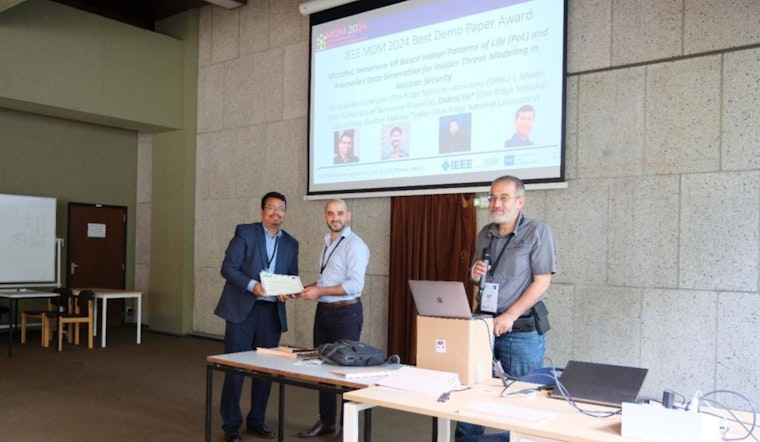
The efficacy of the team's work was recognized with the Best Demo Paper award at the 25th IEEE MDM'24 conference in Brussels, Belgium, and their findings are slated to appear in the Proceedings of the 2024 Interservice/Industry Training, Simulation, and Education Conference and Proceedings of the 2024 Winter Simulation Conference. As for practical applications, beyond threat detection, the simulation can also serve as a training tool for emergency response teams in scenarios that are otherwise hard to access or reproduce safely.
Funded by ORNL's Laboratory Directed Research & Development Program, the project exemplifies the laboratory's commitment to using cutting-edge technology for national security purposes. ORNL operates under UT-Battelle on behalf of the Department of Energy's Office of Science, devoted to resolving critical scientific challenges.





