

























































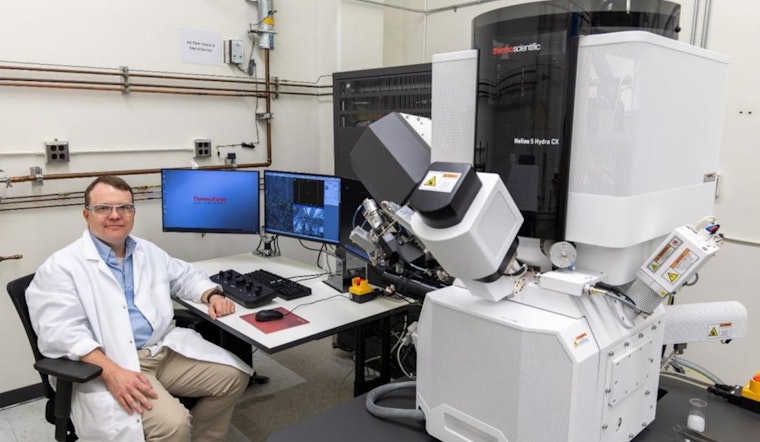
Chad Parish's knack for problem-solving is shaping materials crucial to nuclear safety, a role he's well-acquainted with at Oak Ridge National Laboratory's LAMDA laboratory. His work delves into the microscopic world of atomic structures, contributing substantially to nuclear reactor development. According to a recent expose by ORNL News, Parish is a go-to expert within the lab for tough problems, productively engaging in wide-ranging collaborations tied to materials subjected to extreme conditions and national security concerns.
From an early age, Parish gravitated towards the sciences, with interests that spanned chemistry to paleontology, though athletics didn't capture his attention. He said in a statement made by ORNL News, "My interests wandered around from week to week," adding, "They would go from chemistry to physics to paleontology, but I was always focused on some sort of science. I was terrible at sports." Immersed in a family environment rich with diverse influences, his early flirtation with computer programming did not transform into his chosen career path, yet it bestowed a competitive advantage in his scientific endeavors.
His academic voyage began with chemical engineering at North Carolina State University, but a mandatory exploration of different engineering programs led him to materials science and engineering. Parish recalled the pivotal experience, saying, "The zoom knob went click, click, click, and tiny details were coming into view. I thought, ‘This is it. This is my stuff right here.’" This discovery propelled him towards metallurgical experimentation, subsequently equipping him with the expertise in electron microscopy that became a cornerstone of his professional journey.
After honing his craft by studying galvanizability of steel at the University of Pittsburgh and pursuing a doctorate focused on optoelectronic devices, Parish gained further experiences at Sandia National Laboratories. There, his childhood programming skills proved fruitful for his data analysis work with electron microscopes. "In that way, two things of very different origins in my life merged not only to help me with the Sandia research but also to prepare me for some of the needs ORNL had at the time,” Parish elaborated in a conversation with ORNL News.
Parish's contributions since joining ORNL have been multifaceted, including foundational work on materials for nuclear safety. His role was critical as the lab turned its focus to developing accident-tolerant materials in the aftermath of the Fukushima meltdown. He explained the importance of his work: "The evolution of the material can’t be modeled unless the starting microstructure is known. That’s the kind of information I’m giving them, and we’re doing exciting research with wide implications," as mentioned by ORNL News. Moreover, his influence extended to collaborations with various institutions, where complementary strengths in research and development were strategically harnessed to innovate fusion and fission materials.
Day in and day out, Parish offers his unique insights to colleagues confronted with unresolved material challenges. His multidisciplinary prowess enables him to unearth chemical interactions and microstructural anomalies that often escape others. As he put it, "What I bring to the table is that I’m reasonably good at several different things, which makes me well positioned as a crosscutting problem solver." This approach solidifies the role of UT-Battelle-managed ORNL in pushing the envelope of physical sciences research, an effort well captured by the ORNL News report on Parish's impactful career.





