

























































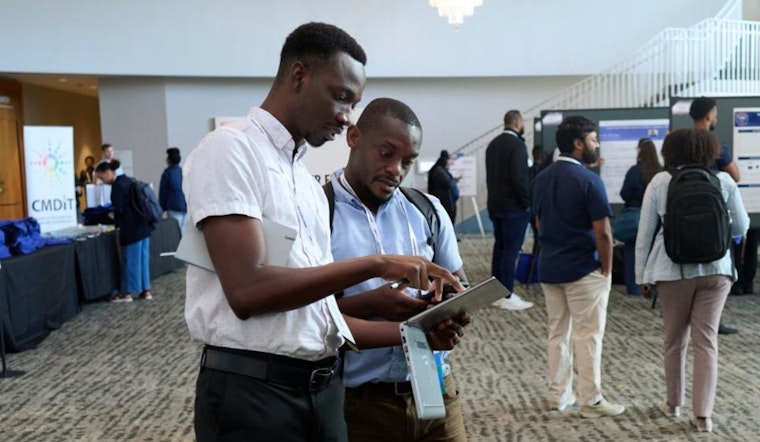
The National Center for Computational Sciences (NCCS) at the Department of Energy's Oak Ridge National Laboratory (ORNL) has been broadening its educational outreach through a series of notable appearances at recent computing conferences. In efforts to enhance the understanding of high-performance computing (HPC) fundamentals among young professionals, NCCS staff has delivered presentations and workshops across multiple events.
Notably, the Oak Ridge Leadership Computing Facility (OLCF), a branch of the NCCS, made its presence felt at the Tapia Conference held in San Diego, California, carrying forward the torch of computational innovation. Representing the OLCF, experts provided insights into the field of HPC, which is crucial for tackling complex scientific problems. Running parallel to these efforts, the staff showcased their expertise at the Society for Industrial and Applied Mathematics Conference on Mathematics of Data Science in Atlanta, Georgia, a gathering focused on the increasingly critical area of data science mathematics.
According to an announcement by ORNL, these initiatives are part of a broader strategy to educate emerging talent and stimulate interest in computational sciences. During these engagements, NCCS staff transcended beyond mere technical instruction, offering a glimpse into practical applications and career development opportunities within the field.
The significance of these outreach efforts lies not just in disseminating knowledge but also in building a community around high-performance computing. By engaging with attendees at the Tapia and SIAM conferences, ORNL hopes to inspire a new generation of computing professionals to push the boundaries of scientific research. Spanning from basic HPC principles to more complex applications, the topics covered by the staff are said to have been both comprehensive and accessible, making them pertinent for those just beginning their journey in the industry.
Through participation at these conferences, the OLCF and NCCS not only reaffirm ORNL's commitment to education but also support the progression of computational sciences as a discipline. As these outreach activities continue, the hope is that the knowledge shared by ORNL staff will ripple out, enhancing the skills and capabilities of young professionals in high-performance computing for years to come.





