

























































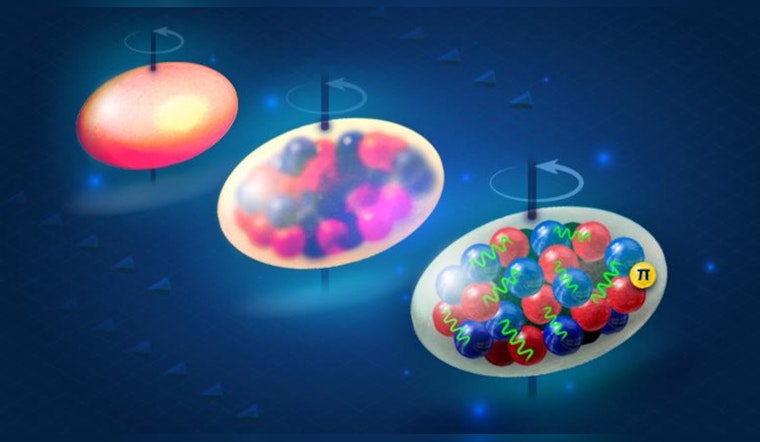
The scientific community is buzzing with news from the Oak Ridge National Laboratory, where researchers, using the powerful Frontier supercomputer, have unveiled a revolutionary method for predicting detailed nuclear structures, a breakthrough detailed in their recent study published in Physical Review X. The technique casts light on the intricate relationship between the structure of an atomic nucleus and the force that glues it together, with implications that span across quantum physics, energy production, and national security.
According to Louisiana State University's Zhonghao Sun, who was formerly part of ORNL, "Our reliable predictions will bring new insights to the study of nuclear forces and structure," as reported by Oak Ridge National Laboratory on their website. The study tackled the historically tough problem of computationally modeling various nuclear features, including shape and energy dynamics; these models previously could not encompass the highly detailed structures and behaviors of subatomic particles at varying energy levels whose behaviors morph, but now with Frontier's processing power, researchers can observe how a nucleus might exhibit both a spherical and a deformed, football-like conformation.
In a low-resolution view, one might simplistically liken a nucleus to a rotating liquid drop, but it's when the magnification ramps up that the truly remarkable nuances in structure emerge, Gaute Hagen of ORNL explained, and he told Oak Ridge National Laboratory that, "As resolution increases, you see more details about the internal structure, and more is learned about how subatomic particles interact to build the nucleus." This leap in resolution is thanks to Frontier, an exascale contender in computing that can conduct over a quintillion calculations per second, propelling nuclear physics into a new era of precision.
Markedly, their research threw the spotlight on an unusual nucleus, 30-neon; findings indicated that this nucleus possesses both spherical and distorted states coexisting through the motivative power of the 'strong nuclear force,' which is the crux of subatomic particle cohesion. Additionally, these revelations have paved the way for developing practical models for predicting nuclear characteristics. Models that once required the heft of Frontier for their initial creation can now be operated from something as common as a laptop, thus setting the stage for extensive, decentralized future research endeavors.
This advancement was supported by the DOE Office of Science Office of Nuclear Physics and Office of Advanced Scientific Computing Research, with Frontier housed at the Oak Ridge Leadership Computing Facility, a DOE Office of Science user facility, managed by UT-Battelle for the DOE Office of Science, marking an important milestone in basic research funding, as per a report by Oak Ridge National Laboratory.





