

























































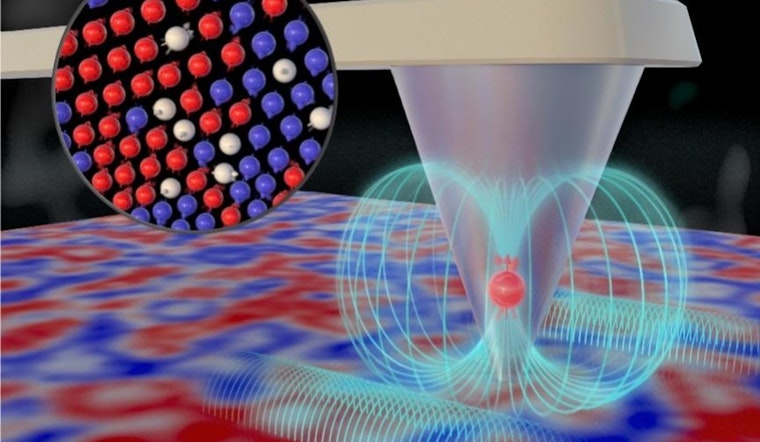
In a significant stride forward for the quantum materials sector, scientists at the Department of Energy's Oak Ridge National Laboratory have unlocked a new method for measuring magnetic fluctuations in materials at the nanoscale. Employing the advanced scanning nitrogen-vacancy center microscope, this team successfully navigated the subtleties of spin behavior in magnetic thin films, as reported in Nano Letters—a development that opens doors to optimizing next-generation technologies ranging from everyday computing to the burgeoning realm of quantum computing.
The researchers focused on magnetic films that possess room-temperature magnetic properties critical for the refinement of data storage and electronic devices. Interestingly, these films undergo phase transitions, which are essentially temperature-induced alterations that greatly impact their fundamental characteristics. Utilizing a single quantum bit, or qubit, the scientists at ORNL were able to measure these spin fluctuations within the magnetic thin film, which are usually undetectable through conventional methods. Ben Lawrie, a research scientist part of the ORNL's Materials Science and Technology Division mentioned, "The nitrogen-vacancy center functions as both a quantum bit, or qubit, and a highly sensitive sensor that we moved around on top of the thin film to measure temperature-dependent changes in magnetic properties and spin fluctuations that cannot be measured any other way," as reported by ORNL News.
This measurement technique, rooted in the precision of quantum mechanics, specifically targets the erratic spin fluctuations in magnetic materials. These fluctuations are moments when the spin orientation within a material unexpectedly shifts direction. By closely examining the phenomenon at nanometric levels during a phase transition, the team gained insights into how interconnected local changes contribute to global phenomena near critical transition points, thus painting a more comprehensive picture of the materials' behavior at pivotal moments.
Understanding these behaviors aids considerably in developing spin-based technologies, which promise to enhance not only digital storage and computing efficiency but could also play an instrumental role in the advent of quantum computing. Lawrie elucidated the potential impact of their findings: "Advances in spintronics will improve digital storage and computing efficiency. Meanwhile, spin-based quantum computing offers the tantalizing promise of classically inaccessible simulation if we can learn to control interactions between spins and their environment." The implications of their work stretch across various aspects of modern and future technological applications, positioning ORNL as an integral player in propelling the field.
With funding support from the DOE Basic Energy Sciences program, the collaboration at ORNL bridges the gap between quantum information science and condensed matter physics. These efforts not only pave the way for improved contemporary devices but also assist in the conceptualization and creation of novel quantum apparatuses for use across multiple technology sectors, including networking, sensing, and computing. As the single largest supporter of basic physical sciences research in the United States, DOE’s Office of Science continues to tackle pressing challenges by nurturing such ground-breaking research and development projects.





