

























































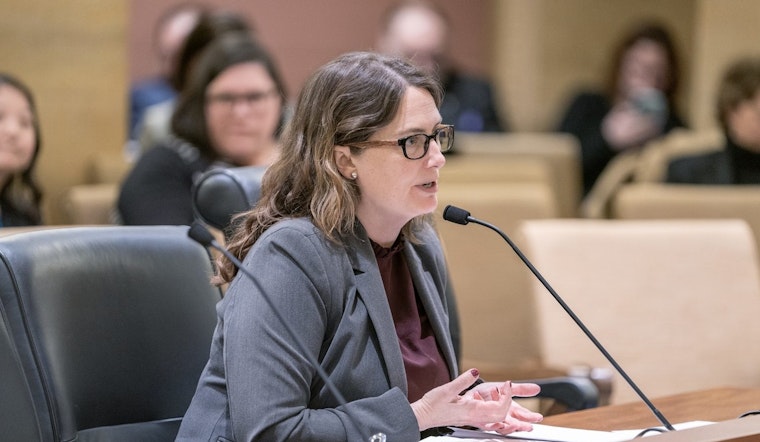
As Minnesota's fiscal horizon reveals a projected surplus turning leaner, Senator Jen McEwen (DFL-Duluth) has issued a statement that cuts through the usual austerity narrative. According to a forecast released by Minnesota Management and Budget (MMB) on Thursday, the state is looking at a $456 million surplus for the fiscal years 2026-27. However, this figure comes in at $160 million lower than previous projections from November 2024—a change attributed by MMB to federal uncertainty.
In a response that shines a spotlight on a starkly inequitable economic landscape, McEwen challenged the scarcity rhetoric that frequently accompanies fiscal forecasts. In a statement released by senatedfl.mn, she claims that the budget shortfalls are "due fundamentally to the lack of political courage we see now across both major political parties to even consider raising taxes on the ultra-wealthy or giant corporations." McEwen doesn't mince words, pointing out that "the richest 1% of Minnesotans now own nearly a third of the wealth in our state."
Moving beyond critique, McEwen calls for a reimagining of public policy, urging Minnesotans to reject narratives of scarcity and to demand robust public goods and services, including universal healthcare and tuition-free education. The sentiment echoes a deep-seated desire for an equitable distribution of resources that serves the common good, rather than the concentrated wealth of an elite few.
Capitalizing on a moment of fiscal reflection, the Senator's statement also embodies a call to action, reading as a rally cry for solidarity among citizens. "It will take all of us, together, rising up and demanding better from our elected officials, regardless of party, in order to get there," McEwen told senatedfl.mn. With a commitment to the fight for more equitable solutions, McEwen's words strive to shift the debate from one of limitation to possibility, framing Minnesota’s fiscal challenges as an opportunity for collective advocacy towards a more socially just future.



