

























































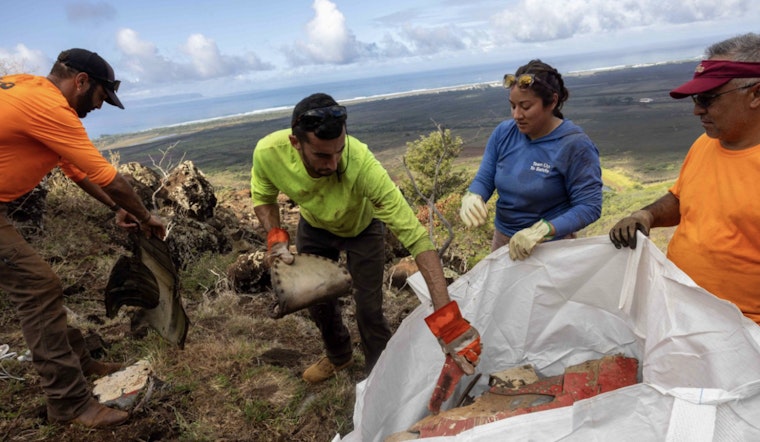
Volunteers have successfully cleared a historic missile debris from Hawaiian home lands on Kaua'i. This cleanup effort took place 800 feet above sea level on the Niu Valley Ridge, involving a nearly 24-mile journey conducted by ATV. An estimated 2,300 pounds of debris was collected on December 19, 2024, and was later airlifted by Jack Harter Helicopters for recycling at Resource Recovery Solutions in Līhuʻe, as reported by the Department of Hawaiian Home Lands (DHHL).
The debris, dating back over six decades, is a remnant of an inert testing missile that crash-landed during Operation Regulus. It was first discovered in 2022 by a DHHL lessee, and the site was carefully assessed for safety. The Kauaʻi Police Department, Navy Security, and Spill Prevention, Control, and Countermeasures personnel declared the area safe after it was uncovered by a herd of feral goats grazing in the area. Specialists from Oʻahu later confirmed there were no explosives, allowing the debris to remain until its recent removal.
Thomas Nizo, a local Anahola residential lessee and the first Native Hawaiian to serve as the deputy public works and stewardship officer at Pacific Missile Range Facility Barking Sands (PMRF), showed a strong dedication to the cleanup process. He emphasized the importance of achieving a positive outcome, or as he put it, getting to a "yes" response, highlighting not only the action but also the responsibility, or kuleana, to care for the land. "E pane mai ka nonoi o Nohili," meaning "answering the requests of Nohili," Nizo told DHHL.
Operation Regulus, which ran from 1956 to 1964, was a series of missile launch and guidance training exercises. The training missiles used, like the debris just cleared, were never armed and were designed to be reusable. This cleanup aligns with the values of Prince Jonah Kūhiō Kalanianaʻole, as DHHL oversees the land's development with the intention to foster a self-sustaining community. This act allows for more effective land use, which can include residential and subsistence agricultural homesteads, along with community spaces and opportunities for traditional cultivation, like that of kalo. For more details on the plan, you can check the Kauaʻi Island Plan by visiting the DHHL media release.
The DHHL manages over 14,500 acres in Waimea on Kaua'i, with much of the area consisting of rugged mountainous terrain and secluded valleys. The ongoing efforts to remove remnants from the past are facilitating future development, highlighting the department's focus on both the land and its residents. The work carried out by Nizo and his team is not only an environmental cleanup but also a step toward supporting future community development, with the land potentially offering new opportunities and resources for the people of Kaua'i.





