

























































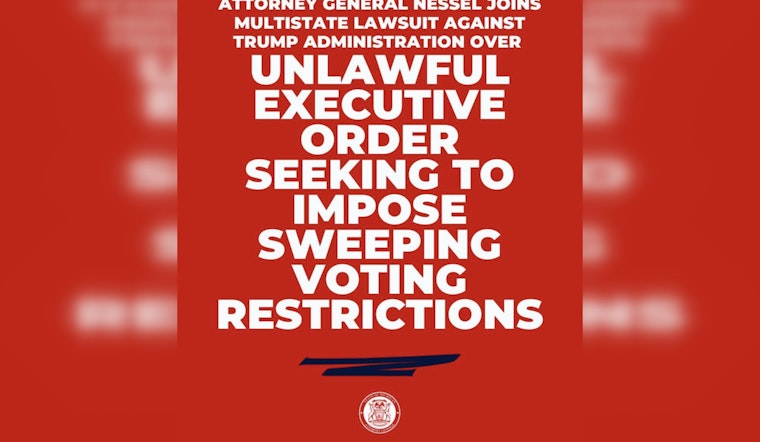
Legal action has been initiated against the Trump Administration's recent attempt to enforce new voting restrictions throughout the United States. The charge, led by Michigan Attorney General Dana Nessel, challenges an Executive Order seen as a direct challenge to the state's authority over election laws. In a concerted effort, 19 attorneys general from various states have filed a lawsuit that portrays President Donald Trump's Executive Order No. 14248 as a clear overstep of presidential authority.
The controversial executive order intends to impose strict proof-of-citizenship requirements for voter registration and revise established procedures for ballot counting. However, as reported by the Michigan Attorney General's Office, these actions interfere with practices that are not only practical but have also been fundamental in ensuring the fair expression of citizens' voices through their vote.
The legal stance, articulated in the lawsuit filed in the U.S. District Court for the District of Massachusetts, holds that the regulation of elections is reserved for the States and Congress, not the Executive Branch. It asserts that the Elections Executive Order is both beyond the scope of presidential power and in conflict with the separation of powers — the foundation of American governance. "Not only is Donald Trump’s executive order unconstitutional and undemocratic, it unilaterally disrupts elections in our state, undermining the electoral process for millions of Michigan voters," Nessel stated in the press release.
This collective opposition includes the governments of Arizona, California, Colorado, Connecticut, Delaware, Hawai‘i, Illinois, Maine, Massachusetts, Maryland, Minnesota, Nevada, New Jersey, New Mexico, New York, Rhode Island, Vermont, and Wisconsin, along with Michigan. They are requesting the court to invalidate the contested provisions of Trump's executive order, arguing that they are unconstitutional. The attorneys general seek a judicial block on these provisions to preserve what they assert are rights protected by state constitutions.




