

























































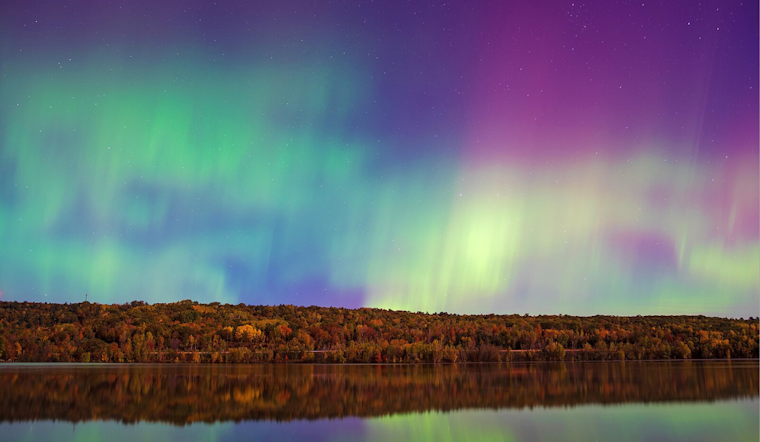
Stargazers and night sky enthusiasts in Michigan and other northern U.S. states might get the rare chance to witness the Northern Lights this week, as a G3 geomagnetic storm watch takes effect. According to CBS News Detroit, Michigan is among the states forecasted to glimpse the auroral display due to a coronal mass ejection expected to hit Earth and trigger a geomagnetic storm.
The National Oceanic and Atmospheric Administration's (NOAA) Space Weather Prediction Center noted that the geomagnetic storm, spawned by solar flares, could lead to disruptions in technological infrastructure, impacting power systems and spacecraft operations. The activity, peaking at a G3 level, suggests strong geomagnetic conditions, and the Northern Lights could be visible as far south as parts of Oregon and the lower Midwest, WXYZ reported. Residents longing to see the auroras may need to travel, even though the auroras should be easily visible away from city lights.
What brings this spectacular light show to skies more accustomed to the dark of night is a series of coronal mass ejections that left the sun on April 13, with G1 (minor) conditions expected to continue into April 17. As described by USA Today, the charged solar particles are interacting with Earth's magnetosphere, triggering the Northern Lights more widely visible than usual.
While the majesty of the auroras typically graces those living closer to the magnetic poles, the ongoing solar activity, part of the sun's 11-year cycle, currently at its peak, has expanded the dance of light across North America. The phenomenon forms when charged particles collide with atmospheric gases, releasing energy in the form of luminous color. The Kp index, indicating geomagnetic activity, is currently at a level 5, hinting at an "active aurora." Most prime for aurora sightings are within an hour or two of midnight, given clear weather conditions, so those with clear skies still have a chance to witness the spectacle tonight, with viewing opportunities extending to several northern U.S. states, including Washington, Idaho, Minnesota, and Wisconsin, among others.





.jpg)