

























































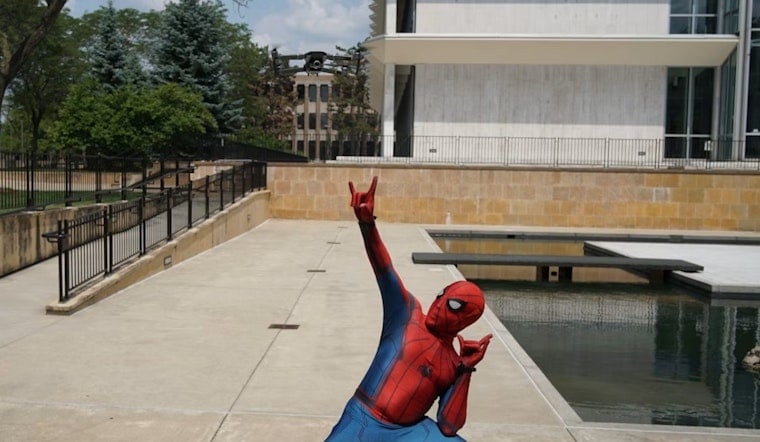
A masked figure in a red-and-blue costume has been showing up on Metro Detroit streets not to fight crime, but to hand out supplies to people experiencing homelessness. Known online as the Spider-Man of Metro Detroit, the costumed activist began homeless outreach patrols in March 2026, connecting with unhoused residents one interaction at a time.
The activist first appeared in costume at a local protest in March 2025 before shifting his focus toward direct community aid, according to WDIV ClickOnDetroit. He said he initially worried people would be uncomfortable approaching a masked stranger, but he told the station the response to his outreach has been overwhelmingly positive. Some people he's met during patrols have told him his work inspired them to help others in their own communities.
His motivation, he says, traces back to a lifelong passion for Spider-Man combined with a sense of helplessness watching people struggle on the streets. He has said he felt powerless seeing that struggle up close, and realized he could merge his love of comics and cosplay with a genuine desire to help his neighbors. Clips of his patrols have gone viral on TikTok, though he has said he hopes the attention stays focused on the people he's helping rather than on himself.
A Movement With West Coast Roots
The Spider-Man of Metro Detroit discovered the broader real-life superheroes community after starting his own outreach, and cites the Batman of San Jose and Crimson Fist of the Bay Area Superheroes as direct influences who showed him he could combine comic-book fandom with meaningful community service. The Batman of San Jose began distributing food, clothing, and water to unhoused residents back in June 2019 and later received a formal certificate of commendation from San Jose Mayor Sam Liccardo in July 2020, according to the RLSH Wiki. He and Crimson Fist went on to co-found the Bay Area Superheroes collective in 2023, an effort that distributed more than 1,200 gallons of water to unhoused encampments during extreme heat waves, as reported by Metro Silicon Valley.
The real-life superheroes movement itself spans hundreds of costumed activists worldwide who take on comic-style alter egos strictly for non-vigilante activism and mutual aid, according to Community Heroes, a national non-profit network formed in 2026. Community Heroes requires background checks for its members engaging in outreach across the country, and the Spider-Man of Metro Detroit is an official member of that network. Organizations within the movement explicitly prohibit vigilante action, keeping the focus on theatrical community aid rather than crimefighting.
Legally Masked, Publicly Visible
Michigan law gives costumed activists like him legal cover to operate openly. Under Michigan Compiled Laws § 750.396, wearing a mask or facial covering in public only becomes a misdemeanor if it's intended to facilitate a crime, a distinction that permits costumed community activists and cosplayers to work in public spaces without legal jeopardy. Separate provisions under Michigan penal law § 750.217 target disguises meant to intimidate public officials or obstruct law enforcement, but don't apply to outreach work like his.
Beyond his homeless outreach patrols, the Spider-Man of Metro Detroit has expanded into broader civic engagement, appearing at suburban gatherings including the Warren City Pride Festival in Macomb County on June 13, according to Community Heroes. He appears across Metro Detroit conducting his patrols one at a time, using public visibility built through appearances and social media to keep drawing attention back to the people he's trying to help.
The Numbers Behind the Need
His outreach unfolds against a backdrop of persistent need across the region. The Homeless Action Network of Detroit's 2025 Point-in-Time report recorded 1,442 people staying in emergency shelters or transitional housing across Detroit, Hamtramck, and Highland Park, a 2% increase from the 1,420 sheltered individuals counted the year before. That count included 726 single adults over age 25 and 609 individuals in parenting families, per the network's data.
The network conducted its most recent overnight street count in January, deploying volunteer teams alongside Street Ambassadors — people with personal experience of homelessness — to locate unsheltered residents and hand out thermal blankets, gloves, winter hats, and hygiene packages, according to the Homeless Action Network of Detroit. Research from Michigan State University political scientists published in April 2025 found a 45% surge in child homelessness in Detroit, with 455 unhoused children recorded during the 2024 count compared to 312 the year before. Researchers also noted that roughly 1 in 19 Detroit Public Schools students experienced unsheltered housing conditions during the 2022–2023 school year.
The City of Detroit and the Detroit Continuum of Care have responded with a 2024–2028 Strategic System Improvement Plan aimed at expanding street outreach and reducing first-time homelessness across Wayne County, according to the city's own documentation. Officials note that standard point-in-time metrics often undercount the true unsheltered population, since people experiencing homelessness are frequently mobile or staying in temporary setups that are hard to track. Formal city strategy and professional ambassador networks handle long-term housing placement, while informal efforts like costumed outreach patrols fill more immediate survival gaps with food and supplies on the ground.



