

























































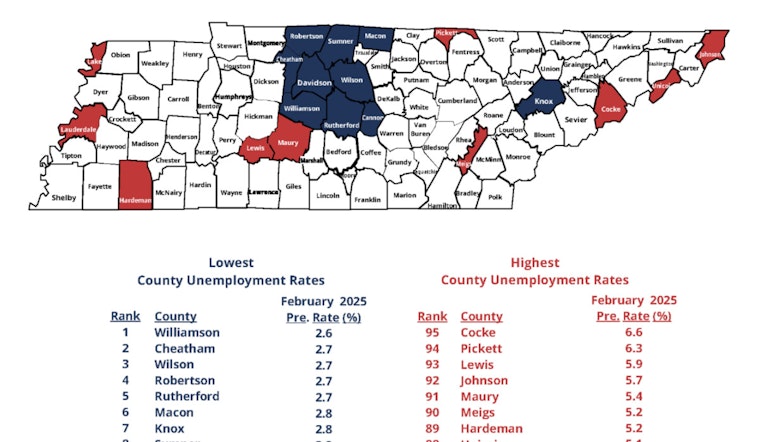
The job market in Tennessee is showing positive trends, with the Tennessee Department of Labor and Workforce Development (TDLWD) reporting a drop in unemployment rates across most counties. In February, 88 out of 95 counties experienced a decrease in unemployment, while two counties saw no change and five counties had a slight increase. Unemployment rates remained below 5% in 84 counties across the state, according to data released and obtained by the TDLWD.
Williamson County recorded the lowest unemployment rate at 2.6%, a decrease of two-tenths of a percentage point from January. Cheatham, Wilson, Robertson, and Rutherford counties each followed with a rate of 2.7%. Macon and Knox counties saw slight increases, with rates at 2.8%. Cocke County had the highest unemployment rate in the state at 6.6%, reflecting a decrease of four-tenths of a percentage point from the previous month.
Pickett County recorded the second-highest unemployment rate at 6.3%, a decrease of seven-tenths of a percentage point from January. Lewis County saw its rate increase from 4.1% to 5.9%, which has raised concerns regarding the local workforce. The statewide unemployment rate has remained steady at 3.7% for the past six months, while the national rate was 4.1% in February. These figures are not adjusted for seasonal employment changes, which sets them apart from other statistical measures.
Job seekers in Tennessee can continue to access free assistance at American Job Centers, where they can participate in one-on-one sessions with career specialists to help navigate the job market. Additionally, for those receiving Supplemental Nutrition Assistance Program (SNAP) benefits, Employment and Training programs are available to address employment barriers through education, skills training, and supportive services. More information on these resources is available on the respective websites. The Tennessee Department of Labor and Workforce Development is set to release the March unemployment data on April 17 at 1:30 p.m. CDT, providing valuable insight into the state’s labor market.



-4.webp?w=160&h=400&fit=crop&crop=edges)
