

























































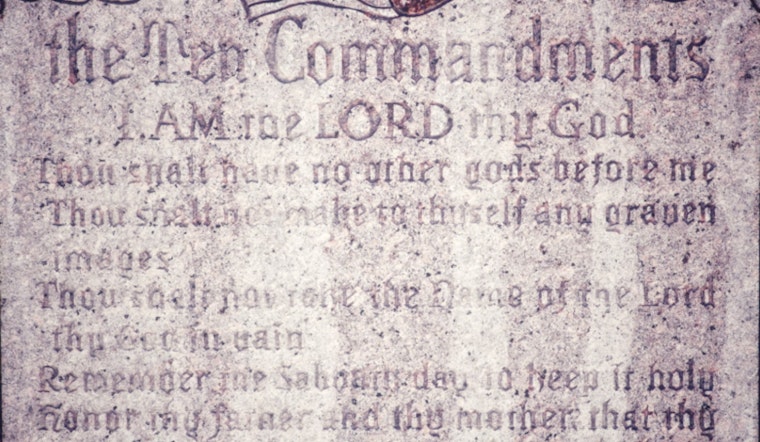
In a decisive swing towards the religious, the Texas legislature has passed a bill that would mandate the display of the Ten Commandments in public school classrooms come September. Despite the implications this has for the separation of church and state, a concept challenged by this decision, the Texas House approved Senate Bill 10 with an 88-49 vote after significant debate, as reported by Click2Houston. The bill's sponsor, Sen. Phil King, and supporters argue for the Commandments as a necessary moral compass and a cornerstone of U.S. history, a viewpoint not without its detractors.
The bill passed, on a Saturday which coincidentally marks the Jewish Sabbath day prohibited by the very Commandments it promotes, as noted by Rep. James Talarico in a move to underscore what he considers legislative hypocrisy. The poster, as dictated by the bill, must be prominently sized at least 16 by 20 inches and cannot include any text other than the prescribed language. Rep. Candy Noble, a Republican from Lucas carrying the bill in the House, emphasized the importance of following "God's law" during the floor debate saying, "It is incumbent on all of us to follow God's law and I think we would all be better off if we did," as reported by Click2Houston.
This legal step is part of a broader national movement to integrate Christian teachings into the public education system. The resurgence of interest in biblical teachings in schools has previously resulted in laws requiring “In God We Trust” displays in schools if posters were privately donated, an act signed into law in 2021. Notably, in 2024, the State Board of Education approved Bible-infused materials for teaching, according to The Texas Tribune.
Despite the Texas House's backing, the bill conflicts, with a federal court decision that struck down a similar Louisiana law on grounds of violating church-state separation. Furthermore, academic and legal experts point out the fundamental difference between personal religious expression and the state-endorsed presence of a sacred text in an educational environment. With reference to a federal ruling last June, George Washington University professor of religion and law, Robert Tuttle expressed his concerns stating, "The constant presence of a sacred text in the room with them is effectively telling them, ‘Hey, these are things you should read and obey,” evident of stepping beyond the state's secular boundaries, as noted by the The Texas Tribune.
The passage of Senate Bill 10 also raises concerns among various groups, from civil rights organizations to the state's teachers union. During committee hearings, some of which stretched into the early hours of 4 a.m., opponents contended that such a policy could alienate students from different faith backgrounds, or who practice no religion, and prompt complex questions irrelevant to secular subjects like mathematics. As for the educators’ stance, Clay Robison, spokesperson for the teachers union, succinctly positioned the union's opposition, "Public schools are not supposed to be Sunday school," capturing the widening gulf between secular education and religious observance stirred by this legislation, as per The Texas Tribune.





