

























































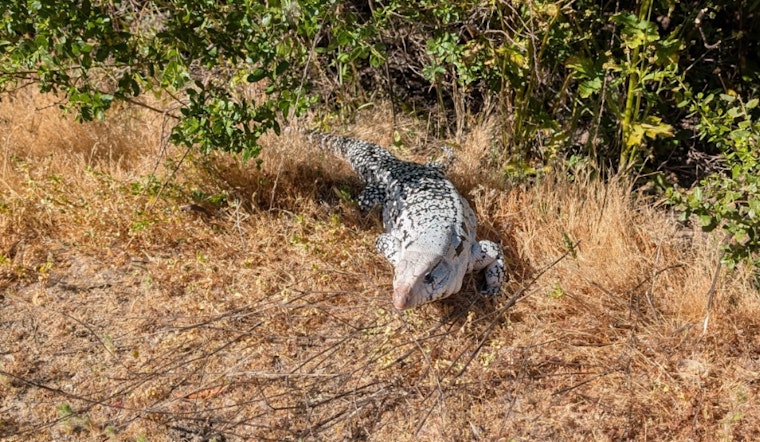
Rangers at Santa Clara County's largest regional park are actively searching for a formidable Argentine black and white tegu lizard spotted by hikers earlier this week, marking another incident of the South American species appearing in California parks.
A group of hikers photographed the distinctive reptile at Joseph D. Grant County Park and promptly reported the sighting to park staff. The Argentine black and white tegu, native to Brazil, Paraguay, eastern Uruguay and northern Argentina, can grow nearly five feet in length and weigh more than 10 pounds.
Park rangers have concentrated their search efforts around Grant Lake, conducting foot patrols to locate the non-native lizard, as earlier reported by Hoodline San Jose. The Santa Clara County Parks Department has urged visitors not to approach, trap, or search for the animal if spotted, instead instructing them to contact park staff immediately or call (408) 274-6121.
A Growing Invasive Species Concern
While tegus are legal to own as pets in California, SF Gate reports they have been prohibited in states like Florida and Georgia due to their devastating impact on native wildlife. The species has earned particular notoriety as University of Florida researchers call them "efficient egg predators," known to consume the eggs of ground-nesting birds, reptiles, and even American alligators.
This California sighting follows a similar incident in 2022 when a tegu was discovered roaming the streets of Folsom. That lizard, named Sully, was reunited with its owner after escaping from an outdoor enclosure. A California Department of Fish and Wildlife spokesperson noted at the time that the state's climate makes it challenging for tropical species to establish permanent populations because "it gets too cold here in the winter."
National Invasion Pattern
Research published by the U.S. Geological Survey suggests that much of the southern United States and northern Mexico contains suitable habitat for tegu species, with the potential for the lizards to spread far beyond their current established range in Florida. In Florida, tegus have been documented in 35 counties, prompting state wildlife officials to implement aggressive removal programs.
The species has also been detected in Georgia, where the Georgia Department of Natural Resources added Argentine black and white tegus to the state's wild animal list in 2022, prohibiting their import and breeding. South Carolina has implemented similar restrictions, requiring current owners to register their tegus and maintain them in escape-proof enclosures.
Joseph D. Grant County Park's Unique Ecosystem
The tegu's appearance at Joseph D. Grant County Park is particularly concerning given the location's ecological significance. As Santa Clara County's largest regional park spanning 10,882 acres, the park provides critical habitat for numerous rare, threatened, and endangered species including the California Tiger Salamander, California Red Legged Frog, and Tricolored blackbird.
The park's historic stock ponds and wetland vegetation serve as essential breeding habitat for protected species, making the presence of an egg-eating predator particularly problematic. Santa Clara County Parks maintains active invasive species management programs, prioritizing newly detected invasive species and those that threaten rare or native plant species.
Pet Trade Connection
Like most invasive reptile populations in the United States, tegus arrive through the exotic pet trade. According to research cited by Big Think, between 2000 and 2015, as many as 79,000 live tegus may have been imported into the U.S., with an undetermined number bred in captivity. Problems arise when these large, intelligent lizards either escape their enclosures or are released by owners unable to continue their care.
The Mercury News noted that on the other side of the continent, Florida's tegu problem has become so severe that officials allow residents to hunt them without permits. The species' adaptability and reproductive success have made them one of the most aggressive invasive species threatening Florida's native ecosystems.
Officials continue their search efforts at the park while maintaining that tegus, despite their imposing size, are generally docile toward humans and pose no direct threat to visitors. Anyone spotting the distinctive black and white striped lizard is urged to maintain a safe distance and immediately contact park rangers.




