

























































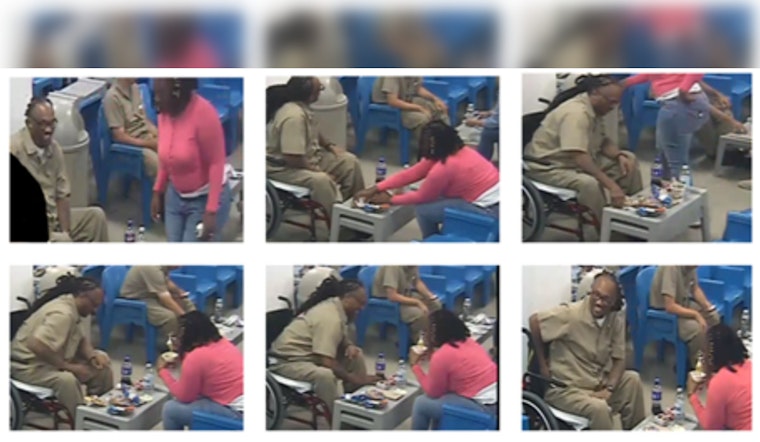
A former employee of the Massachusetts Department of Environmental Protection and a federal inmate are facing charges related to the smuggling of synthetic cannabinoids, commonly known as K2, into FMC Devens, a federal prison. The former state employee, Tasha Hammock, 43, and inmate Raymond Gaines, 45, have been charged with providing and possessing contraband in prison.
According to a recent announcement by the U.S. Attorney’s Office, these charges stem from an incident in August 2024 when Hammock allegedly handed over the K2-laced paper to Gaines during a prison visit. Investigations reveal that Hammock, at the time an employee with the state’s environmental agency, also managed a Bridgewater address allegedly used to receive the drugs before they made their way into the prison. The prison, has been facing severe health issues due to K2, with both inmates and staff falling sick from exposure to the drug.
It appears Gaines, previously associated with the Orchard Park Trailblazers, a Boston street gang, had a history with the law. After a conviction in 2017, he received a sentence over seven years in January 2022 for cocaine possession with intent to distribute and firearms possession. However, this January, he saw a reduction in his sentence through an Executive Grant of Clemency. Despite this second chance, the inmate now potentially faces up to 10 additional years if convicted of the new charges.
The court documents also mention a cellphone that was smuggled into FMC Devens and obtained by law enforcement, which revealed conversations between an inmate identified as "Inmate A" and "Person 1." These messages, dating back to September 2023, discuss how K2 could be delivered to Hammock's residence and later into the prison, through an arrangement with Inmate A's "co." Both defendants, Hammock, and Gaines, are presumed innocent under the law unless proven guilty in court.
Should these charges hold, they could result in sentences up to 10 years, three years of supervised release, and fines of $250,000 for each. The case is currently being prosecuted by Assistant U.S. Attorney Brendan O’Shea, and the investigation has received assistance from the FBI, the DOJ-OIG, and the Special Investigative Services Unit at FMC Devens. The implications of this case extend into the prison's operations as authorities continue to counteract the circulation of dangerous contraband within its walls.



