

























































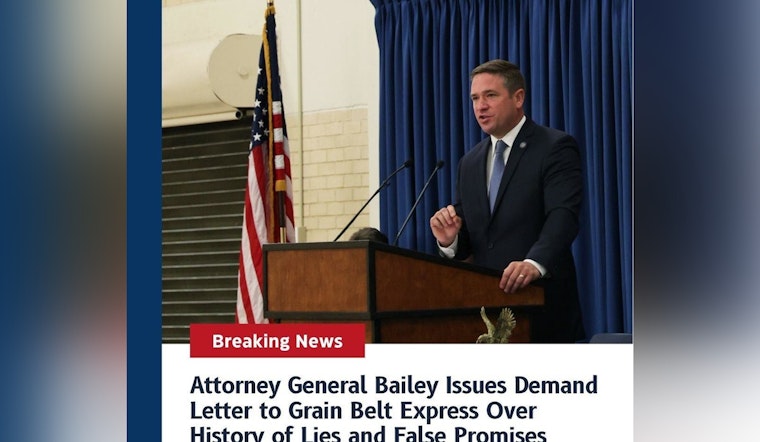
Missouri's battle over energy transmission has taken a significant turn as Attorney General Andrew Bailey zeroes in on Grain Belt Express, LLC (GBE) with a Civil Investigative Demand (CID). Citing widespread concerns over the company's honesty, Bailey has accused GBE of making misleading claims about its large infrastructure project—allegations heavy enough to question previous regulatory approvals. According to a statement obtained by the Missouri Attorney General's Office, Bailey declared, "We will not allow a private corporation to trample property rights and mislead regulators for a bait and switch that serves out-of-state interests instead of Missourians."
GBE, currently supported by a $4.9 billion conditional federal loan guarantee from the Biden Administration, has found itself embroiled in controversy after filing numerous eminent domain lawsuits against Missouri landowners; these suits are not just to acquire land but to push forward a project, that Attorney General Bailey argues, increasingly caters to out-of-state data centers and not the local populace. The New York Times elucidates on Bailey's moves as “a major setback for Invenergy, the energy company that is behind the project...” with potential ramifications that could ripple across Missouri's energy and property rights landscape, as reported by the Missouri Attorney General's Office.
In the face of suspected false advertising and unmet job creation promises, the CID requires GBE to produce substantial evidence backing its justifications for the project. Bailey's letter to the Missouri Public Service Commission (PSC) also carries the heft of his office's support to reassess the Certificate of Convenience and Necessity, which underpins GBE's project, highlighting reliance on assumptions now challenged as speculative and potentially fraudulent. The Missouri Merchandising Practices Act stands as the legal bulwark against such corporate deception, with the Attorney General's Office affirming its intent to hold such businesses responsible.
Bailey's leveraging of recent Federal Energy Regulatory Commission (FERC) Orders, numbered 1920, 1920-A, and 1920-B, emphasizes his call for the PSC to use its full authority to mandate updated long-term planning and revoke project approvals no longer aligned with public interest, making it clear that standing up for Missouri's farmers, families, and landowners is paramount in stopping what he describes as "billion-dollar land grabs disguised as infrastructure." In conclusion, he expressed his resolve, "We are launching this investigation to protect landowners and demand accountability from a project built on broken promises," summing up a comprehensive stance against Grain Belt Express, as per the Missouri Attorney General's Office.





