

























































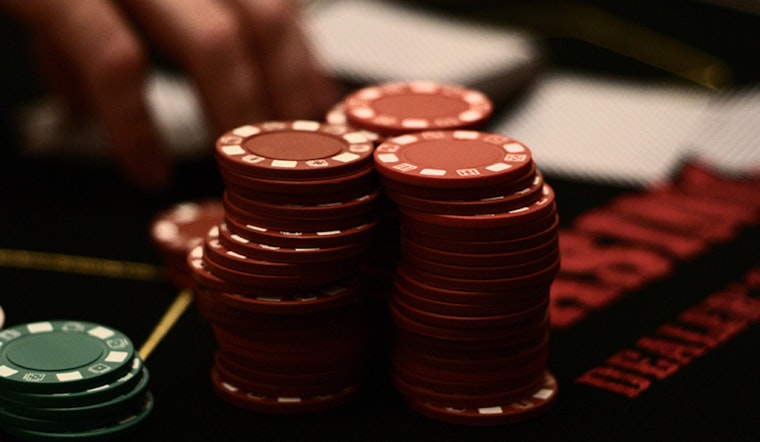
The engine of Detroit's economy has a significant pillar in its casinos, and July's figures are in: the city's three heavy hitters—MGM Grand Detroit, MotorCity Casino, and Hollywood Casino at Greektown—have collectively raked in $107.0 million in revenue. This statistical portrait, presented by the Michigan Gaming Control Board, indicates a continuous prospering of the gambling scene despite minor fluctuations when compared to last year's data.
While table games and slots still dominate the casino floors bringing in the lion's share of $106.0 million of the total monthly revenue, retail sports betting punched above its weight class with $1.0 million—an area showing robust growth and perhaps mirroring an escalating interest in sports wagering. In the market share battle, MGM Grand Detroit holds nearly half the turf at 48%, MotorCity Casino trails with a substantial 30% stake, and Hollywood Casino at Greektown captures a respectable 22%, these figures stand as a testament to the business brought in by locals and tourists alike.
Glancing over the table games and slot machine revenue, there's a slight dip of 0.3% compared with July of the previous year while enjoying a bit of a bump, a 5.6% increase from the earlier summer month of June 2025; this demonstrates a minor ebb and flow inherent in any business reliant on chance and consumer whim. Taking a gaze at each casino's revenue, MGM Grand Detroit saw $50.8 million but registered a small decrement of 0.9%, MotorCity Casino had a minuscule rise with $31.6 million, up by 1.2%, and Hollywood Casino at Greektown echoed MGM's experience with a downshift of 0.9% at $23.6 million—this landscape showing the subtle shifts that casinos need to navigate.
From the perspective of state and city coffers, the casinos delivered $8.58 million in state gaming taxes, a nearly negligible decrease from $8.61 million in July 2024, and they also funneled $12.6 million into Detroit's budget through wagering taxes and development agreement payments—a sizeable contribution to the local economy. Moving over to retail sports betting, the combined handle reached $5.7 million, leading to $1.0 million in gross receipts. Notably, the qualified adjusted gross receipts (QAGR) marked a significant surge of $1.4 million from the previous year and an impressive 55.1% jump from June 2025, showcasing a burgeoning vertical in the casino industry. MGM Grand Detroit's QAGR stood at $190,153, while MotorCity Casino and Hollywood Casino at Greektown posted $468,725 and $373,025, respectively.
The state benefited as well, albeit modestly, with the casinos paying $39,006 in taxes from the retail sports betting revenue, and additionally to the City of Detroit's gain, they submitted $47,674 in wagering taxes.



