

























































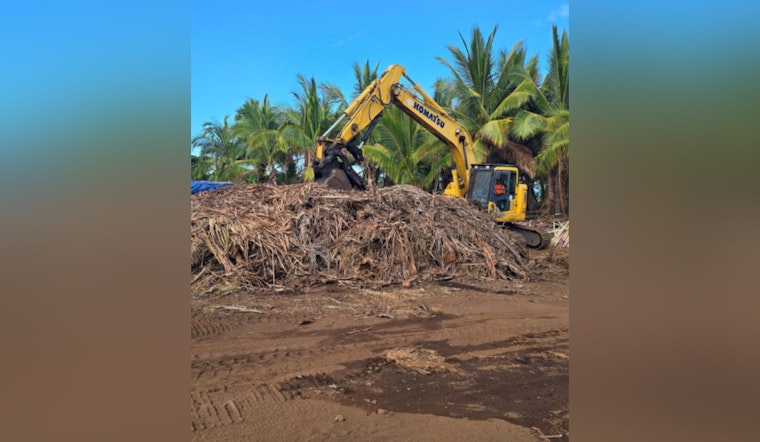
A multi-agency team from Hawai‘i Department of Agriculture & Biosecurity, County of Hawai‘i, Hawai‘i Invasive Species Council, Hawai‘i Department of TransportationT, CRB Response, and Hawai‘i Island Invasive Species Committe worked together to address coconut rhinoceros beetle infestations. They carried out fumigation and removal of green waste at Keāhole Agricultural Park to eliminate coconut rhinoceros beetle breeding sites, according to the Hawai‘i Department of Agriculture and Biosecurity.
On July 28, crews found two coconut rhinoceros beetle breeding sites, discovering 110 late-stage larvae and three adult beetles. They immediately covered the waste with fumigation tarps. A pest-control contractor then fumigated about 1,500 cubic yards of green waste on August 13. After fumigation, HDOT and COH transported and processed the material at a local green waste facility on August 14, 18, and 21 to eliminate any remaining CRB. This took place within a voluntary compliance zone set up by Hawai‘i Island Mayor C. Kimo Alameda in June 2025 to prevent the spread of coconut rhinoceros beetle, as reported by the Hawai‘i Department of Agriculture and Biosecurity.
"It takes an army to battle the CRB threat and we are grateful for our agency partners that have steadfastly supported efforts to eradicate, mitigate and control the beetles," said Sharon Hurd, chairperson of the Hawai‘i Board of Agriculture and Biosecurity. Last Monday, CRB Response staff checked green waste piles at KAP's nurseries and found no more beetles or breeding sites. The DAB team will now treat coconut palms with pesticides and set up more CRB detection traps. People on Hawai‘i Island are asked to report any suspected CRB sightings to the state’s PEST HOTLINE, as stated by the Hawai‘i Department of Agriculture and Biosecurity.





