

























































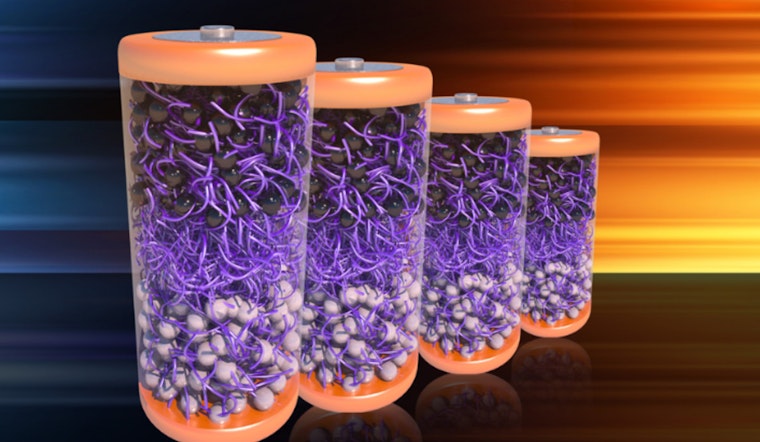
As the electric vehicle industry accelerates, so does the potential for a looming electronic waste crisis. An innovative solution from MIT might hold the key to revolutionizing electric vehicle (EV) battery recycling. A research team at the esteemed institution has unveiled a self-assembling battery material that disintegrates upon contact with a simple organic liquid. This breakthrough, detailed in a recent Nature Chemistry paper, could mark a significant move towards batteries designed with recyclability in mind.
The material primarily acts as an electrolyte in solid-state batteries and is quickly reduced to its molecular components, which could potentially streamline the recycling process. Current recycling methods often shred batteries into mixed, tough-to-process materials. This new approach allows the battery to disassemble, effectively simplifying the separation of components. As Yukio Cho, the lead author of the study, told MIT News, "Our approach is to start with easily recyclable materials and figure out how to make them battery-compatible. Designing batteries for recyclability from the beginning is a new approach."
The innovation draws on aramid amphiphiles (AAs), which self-assemble in water to form nanoribbons capable of conducting lithium ions. This combination of resilience, reminiscent of Kevlar, and ion conductivity could prove integral to creating sustainable, efficient batteries. Upon exposure to water, these AAs quickly transform into a gel, indicating a high volume of nanoribbons ready to be hot-pressed into a solid-state material. The team successfully tested a battery cell using this material, although they acknowledged that performance was hampered by polarization, limiting rapid charging and discharging.
Significantly, when dipped into an organic solvent, the battery dissolves, enabling each part to separate for easier recycling. "So, when you want to recycle the battery, the entire electrolyte layer can fall off naturally and you can recycle the electrodes separately," Cho explained in a statement obtained by MIT News. The team currently aims to fully optimize the material's performance and explore integration with existing battery designs and new battery chemistries.
With the escalating demand for EVs, this research could also help address the critical issue of lithium supply. Reusing materials from recycled batteries may act as an effective domestic source of lithium, mitigating the need for new mines and stabilizing lithium pricing. "If we can start to recycle lithium-ion batteries from battery waste at scale, it'll have the same effect as opening lithium mines in the U.S.," said Cho. This type of innovation not only represents a step forward environmentally but also signifies a potential paradigm shift in how the industry approaches battery life cycle and resource utilization.



