

























































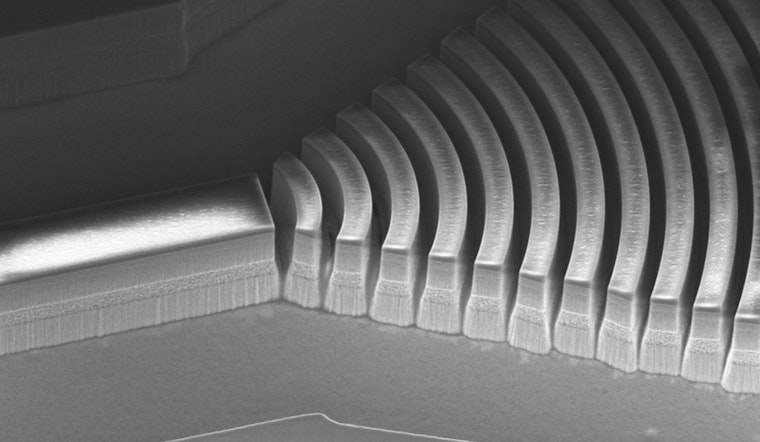
Researchers at MIT have pioneered a new laser "comb" technology, potentially revolutionizing the way we identify chemicals with high precision. In a recent breakthrough reported by MIT News, the team has successfully developed a fully integrated device that employs a finely crafted mirror to generate a stable frequency comb that boasts an impressively broad bandwidth. These devices could be game-changers for producing more efficient environmental monitors capable of detecting harmful chemicals in the atmosphere.
Optical frequency combs work by measuring light frequencies accurately, and are crucial for real-time monitoring of multiple chemicals, until now, achieving the necessary bandwidth for these combs was a significant hurdle, often requiring cumbersome additions that limited both scalability and performance but the group from MIT, consisting of distinguished researchers including Hu, Distinguished Professor in Electrical Engineering and Computer Science and the senior author on their open-access paper, seems to have surmounted these challenges with their innovative mirror design and on-chip measurement platform.
Dispersion, a phenomenon that spreads out light wavelengths, is the main limiting factor for a frequency comb's bandwidth, Hu explained in the MIT report. Overcoming this, according to "Hu told MIT News," required a nuanced engineering approach, and the team devised a double-chirped mirror (DCM) to compensate for the dispersion found in infrared light. This approach overcame the precision fabrication challenges and deep etching into stubborn material layers that had previously roadblocked progress in creating infrared combs.
In the context of their work, the MIT team's device marks a significant step forward for broadband comb performance, Tianyi Zeng, the lead author on the paper and a recent PhD graduate, attested to the intricate process they had to iterate through, stating, "we reached a dead end" before realizing that infrared sources did not require the complex corrugated DCM used for terahertz waves, this realization was a turning point that allowed for a more standard DCM design that was still compatible with infrared radiation but the precision required was still non-trivial, "The adjacent layers of mirror differ only by tens of nanometers," and the combination of precision fabrication and on-chip dispersion measurement was instrumental in their success.
The implications of this work are expansive, with experts in the field such as Jacob B. Khurgin, a professor at the Johns Hopkins University Whiting School of Engineering, praising the work for its "unprecedented control over dispersion" that could lead to practical, chip-scale frequency combs which have applications that range from chemical sensing to free-space communications. Funded by both DARPA and the Gordon and Betty Moore Foundation, the research continues to push boundaries with plans to adapt their method to other laser platforms, aiming for even greater bandwidth and higher power necessary for demanding applications.





