

























































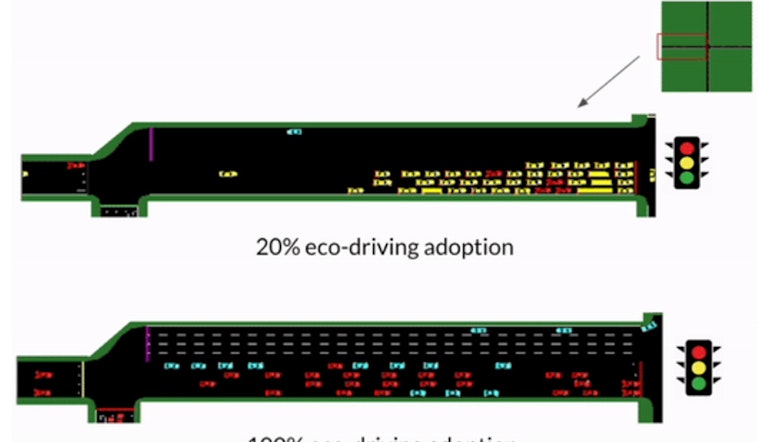
Sitting idle at a red light isn't just a test of your patience—it's also a contributor to carbon emissions. Per an MIT study, unchecked vehicle idling at signalized intersections may be responsible for up to 15 percent of all land transportation CO2 emissions in the U.S. Enter eco-driving measures, which could drastically alter this equation. Researchers at MIT using deep reinforcement learning have found that by dynamically tweaking vehicle speeds to minimize stopping and acceleration, we could see a significant slash in CO2 output—between 11 and 22 percent annually across city intersections, according to a statement obtained by MIT News.
Imagine if just 10 percent of the cars on our roads began to just plug into eco-driving—the results would be remarkable. This modest level of adoption is speculated to yield 25 to 50 percent of the potential reduction in emissions. Moreover, setting dynamic speed limits at about 20 percent of crossroads could achieve 70 percent of these emission reductions, illustrating a powerful case for phased implementation without having to go full throttle from day one.
This isn't just a fanciful prediction. The study conducted by the MIT team, which took nearly four years to complete, didn't cut corners. They thoroughly considered 33 different factors that influence emissions—from the grade of the road to driver behavior. Utilizing data from multiple sources, they digitally replicated over 6,000 intersections in cities like Atlanta, San Francisco, and Los Angeles, simulating over a million traffic scenarios. "Vehicle-based control strategies like eco-driving can move the needle on climate change reduction," MIT's Cathy Wu, associate professor in Civil and Environmental Engineering (CEE) and the Institute for Data, Systems, and Society (IDSS), told MIT News.
Yes, full adoption would be the ideal scenario, but the road towards eco-driving doesn't have to be an all-or-nothing approach. Even small-scale adoption can effectively improve traffic flow and reduce emissions without compromising safety—a win-win for both the environment and commuters. The researchers zeroed in on the cooperative behavior between vehicles, ensuring the eco-driving benefits were not narrowly confined but broadly applied across non-participating vehicles as well. All this was achieved without inducing burdensome communication needs between cars, simplifying the transition toward energy-efficient travel.
Although the research hints at substantial upsides, Wu cautions about possible drawbacks too. Increasing road throughput could attract more drivers, potentially offsetting the benefits. Plus, while safety metrics suggest eco-driving is comparable to human-driven vehicles, more research is needed to fully grasp impacts on road safety. As these analyses mature, eco-driving emerges as a key component to a comprehensive approach in slicing vehicular emissions—especially when paired with the adoption of hybrid and electric vehicles.
Hesham Rakha, the Samuel L. Pritchard Professor of Engineering at Virginia Tech, not involved with the MIT research, hailed the study as "a first attempt to systematically quantify network-wide environmental benefits of eco-driving." With much of the necessary technology already integrated into our smartphones and vehicles, eco-driving stands out as a feasible, scalable solution for today's emission woes. With backing from entities like Amazon and the Utah Department of Transportation, researchers have begun to successfully mark eco-driving as more than a dashboard suggestion—it might just be a promising stride towards a cleaner, more efficient transportation future.





