

























































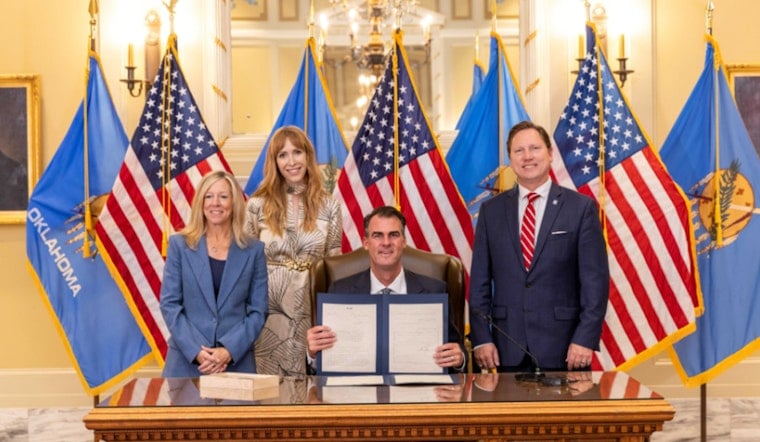
In a move aimed at bolstering Oklahoma's commitment to rehabilitation and workforce readiness, Governor Kevin Stitt and Rep. Brian Hill, R-Mustang, recently held a ceremonial bill signing for House Bill 2364, a legislation designed to expand the Sarah Stitt Act. This act stands as a testament to the state's efforts in not only reducing recidivism but also in supporting citizens reentering society post-incarceration, according to the Oklahoma House of Representatives.
Hill, who authored HB2364, has championed the cause to ensure that eligible inmates are better prepared to seamlessly rejoin the workforce upon their release. The bill requires the Department of Corrections to assist these individuals to quickly obtain a REAL ID noncompliant driver's license or an identification card, a pragmatic step towards reducing barriers to employment. In a statement to the Oklahoma House of Representatives, Hill expressed that "every individual reenters the workforce saves taxpayers more than $20,000 each year," as reported by the Oklahoma House of Representatives.
Since the original Sarah Stitt Act was passed in 2021, Oklahoma has prioritized providing inmates with essential documents prior to their release. This includes vocational training records, work history, and Social Security cards—all instrumental in aiding an individual's transition back into society. The latest expansion detailed in HB2364 takes these efforts a step further by focusing on identification documents, ensuring that upon leaving incarceration, individuals have the necessary paperwork to secure employment, as per the Oklahoma House of Representatives.
"Ensuring that individuals leave incarceration with proper identification is a simple step that makes a big difference," said Hill, underscoring the importance of these measures. The spirit of HB2364 echoes Gov. Stitt’s policy pillars, aligning with Criminal Justice Reform and Classroom to Careers initiatives, which are designed to not only strengthen Oklahoma’s communities but also to boost the state's economy. As part of this legislative package, the state continues to demonstrate its investment in its returning citizens and the collective future of Oklahoma, as stated by the Oklahoma House of Representatives.





