

























































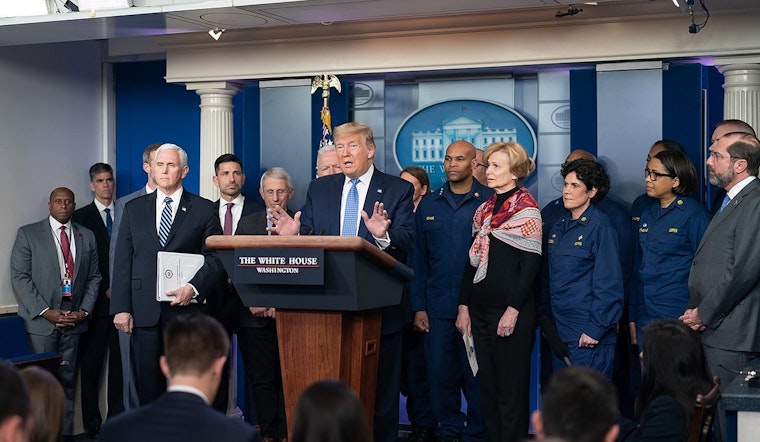
President Trump has taken aim at policies permitting "no cash bail," a stance that aligns with his broader agenda to portray himself as a bulwark against what he perceives as escalating crime rates. He made his opposition quite clear during a recent press conference, where he declared his intent to "rescue our nation's capital from crime, bloodshed, bedlam and squalor," as he announced the federalization of the D.C. Metropolitan Police Department. Alongside this, he singled out cities such as Chicago, where he stated he plans to end the policy of no cash bail, calling out the state’s Governor and Chicago's Mayor as "incompetent," according to an article by CBS Chicago.
The crux of President Trump's criticism seems to be the assertion that any jurisdiction without cash bail is inherently a "disaster." However, recent data from the Justice Department tells a different story, showing that violent crime in Washington, D.C. is at its lowest level in over three decades. Meanwhile, in Chicago, data indicates that the absence of cash bail has not led to a rise in crime, with both violent and property crimes registering a downturn. This data evidently contradicts the narrative presented by the President. He went so far as to vow to "change the statute" in Chicago, a promise that could potentially upheave the legal landscape significantly, possibly requiring congressional intervention.
Illinois, after implementing the SAFE-T Act, became the first state in the U.S. to eliminate cash bail, debunking concerns that it would lead to spikes in crime rates. According to data from September 2024 reported by NBC Chicago, crime did not experience an increase as a result of the no cash bail policy; in fact, instances of violent crime had decreased. This trend seems to continue, as indicated by recent statistics up to July 2025.
Despite these reports, President Trump has insinuated he would quickly engage Congress to amend statutes related to no cash bail, though he failed to provide specific strategies or dates for when these changes would take place. Any federal actions to alter state policies will likely be met with significant legal debate and opposition, given the jurisdictional complexity and constitutional questions such changes would invoke. In the face of Trump's comments, Gov. JB Pritzker took to X.com to deliver a pointed response, emphasizing that the President does not possess the authority to take over Chicago's police department.
Mayor Brandon Johnson also responded, highlighting that significant progress had been made in the reduction of homicides and shootings under his tenure. In his statement, obtained by CBS Chicago, Johnson called out Trump's administration for cutting funds deemed essential for anti-violence programs, which have been central to the city's successful efforts in lowering crime rates. He condemned the idea that sending in the National Guard would contribute positively to Chicago's safety, rather asserting that it would undermine ongoing public safety efforts. The White House has yet to respond to Johnson's call for the restoration of funding for these critical anti-violence measures.



.jpg)