

























































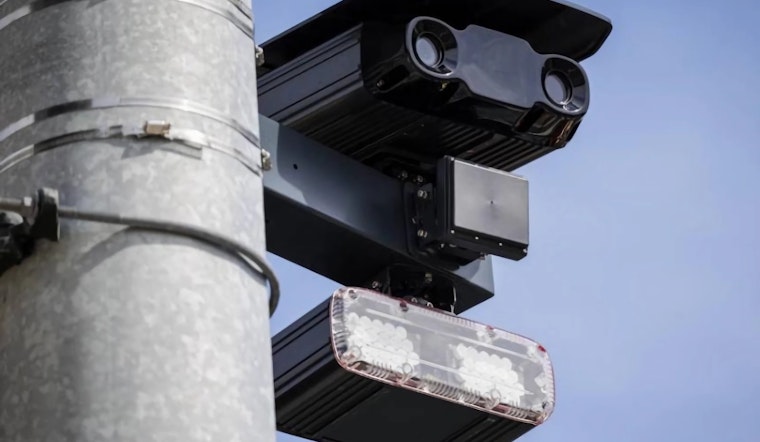
The long-awaited moment has arrived—and it's sparking fierce debate about whether this is genuine public safety or sophisticated revenue collection. San Francisco's network of 33 automated speed cameras began issuing real tickets with real fines today, marking the end of a months-long "grace period" that has divided residents between those who see life-saving technology and those who see the city's newest money machine. Jump to the Map ↴
Mayor Daniel Lurie announced the transition from warnings to citations, emphasizing early data showing measurable changes in driver behavior during the warning phase. The data also showed 350,000 speed violations since the program launch—a staggering number that both safety advocates and critics point to as evidence supporting their opposing views.
Starting today, 33 speed cameras across San Francisco will begin issuing fines. These cameras have already shown results during the warning period, with fewer notices issued over time—a sign that drivers are slowing down.
— Daniel Lurie 丹尼爾·羅偉 (@DanielLurie) August 5, 2025
Speed cameras are a proven tool to make our streets… pic.twitter.com/Wd7NVlWlNW
The Safety Case: Lives Over Revenue
For safety advocates who have fought for this technology for over a decade, those 350,000 violations represent 350,000 potential tragedies prevented. "Speed cameras dramatically shift behavior and can reduce the number of severe and fatal crashes by as much as 58 percent," said Marta Lindsey from Walk San Francisco, according to Streetsblog San Francisco. Speed cameras are a proven tool to address excessive speeding and reduce severe and fatal injury traffic collisions, according to the SFMTA.
The urgency behind the program becomes clear when examining San Francisco's grim traffic safety record. Since San Francisco adopted its Vision Zero program in 2014, 367 people have been killed by traffic violence on its streets, according to San Francisco Traffic Violence Analysis. That equates to a traffic related fatality every 11.44 days. In 2024 drivers killed 44 people on our streets.
Jenny Yu, whose mother was struck by a speeding SUV 14 years ago at Park Presidio and Anza and suffered a traumatic brain injury, sees the cameras as overdue intervention. "Geary Street has statistically a lot of fatalities," Yu told ABC7. "This is personal for me, and for so many others who have lost loved ones to traffic violence."
The Revenue Reality Check
Critics aren't wrong about the money potential. The SFMTA found that the worst location for speeding was the section of Geary between 7th and 8th Avenue. They calculated that 4,440 cars were driving at 11 miles or more over the speed limit in a single day, as reported by ABC7 San Francisco. Simple math reveals the potential: If you multiply 4,400 cars on Geary between 7th and 8th going at least 11 miles over the speed limit by $50, that's $220,000 at one intersection alone in one day.
The National Motorists Association isn't buying the safety rhetoric. "The pilot program is nothing more than a revenue-generation scheme disguised as a safety initiative," said Jay Beeber, the executive director of policy for the National Motorists Association, according to The Examiner. "The vast majority of tickets will be issued to drivers on roads with unreasonably low speed limits that do not align with the roadway's design," he said.
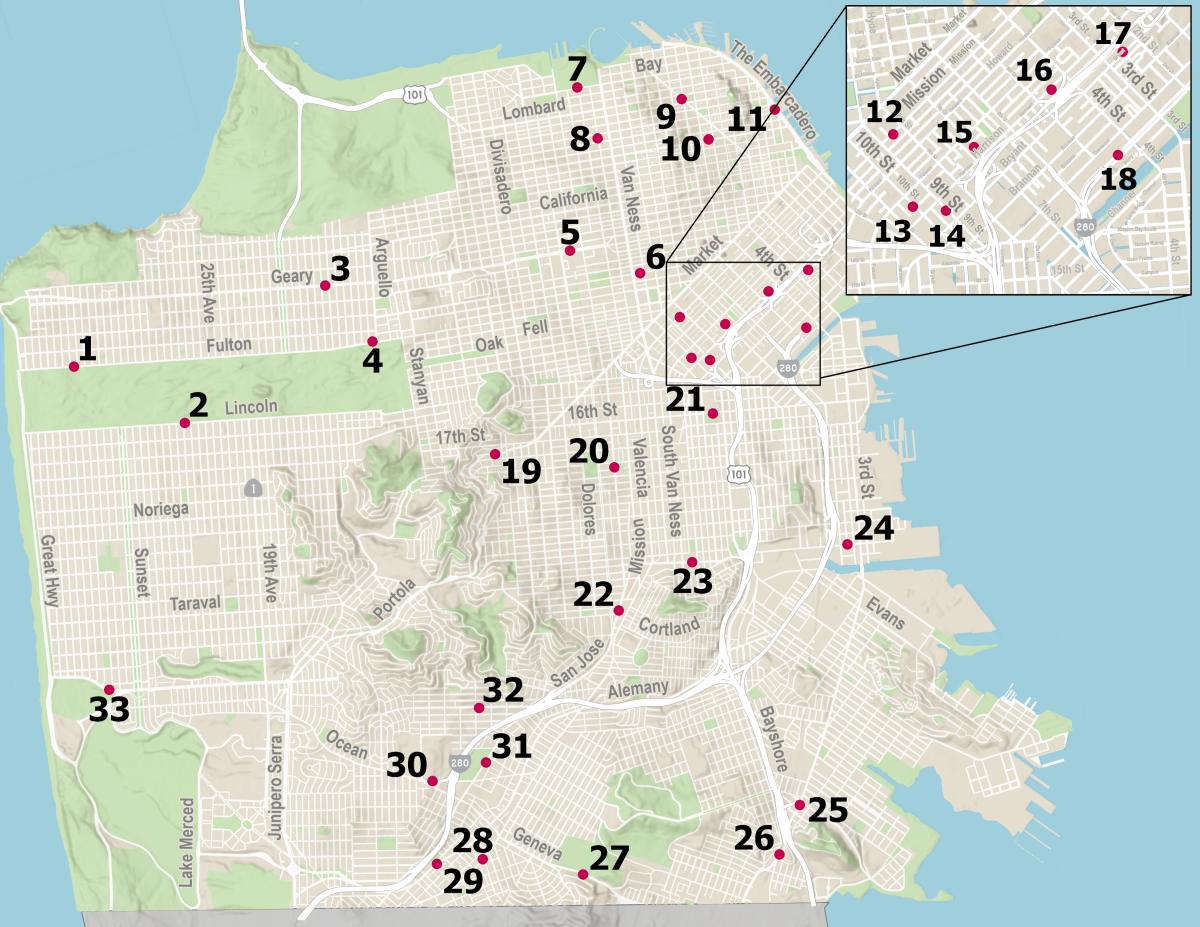
Source: SFMTA
Mixed Community Response
The cameras aren't randomly placed—they're strategically positioned on the city's "High Injury Network," the 12% of streets where 68% of severe and fatal collisions occur. But community reactions vary widely based on personal experience and perspective.
Some residents remain skeptical of the city's motivations. The couple, who live on Potrero Hill, said they didn't really understand why the cameras had gone up along an intersection they called "benign." The main feeling Dean had was that it was "more revenue for the city." One resident told The Chronicle: "For the 15 years that I've lived here, I've never thought of San Francisco as a traffic violation revenuer, more focused on actual crime and other things".
Others see them as necessary intervention. "We are thinking that this is going to be a game changer, absolutely," said Jodie Medeiros of Walk SF, according to ABC7. "It is, year after year, speed is the number one cause of all the crashes that we're having and therefore we need to do something that is going to curb speed."
Vision Zero's Failure Creates Urgency
The speed camera rollout comes against the backdrop of San Francisco's struggle to achieve its Vision Zero goal of eliminating traffic deaths by 2024. With 32 fatalities, 2024 has already tied 2016 as the second-deadliest year since the city took the Vision Zero pledge — and there are still seven weeks to go, as reported by The Standard. Despite a decade of work and a budget of hundreds of millions of dollars, San Francisco's 2014 Vision Zero initiative, aimed at eliminating traffic deaths in the city by 2024, never achieved its ambitious goal.
For city officials, this failure underscores the need for more aggressive intervention. "Automated enforcement tools are a critical part of our public safety tool kit," Mayor Lurie said, according to CBS San Francisco. The City's Vision Zero policy expired last year, and the last interagency action plan for Vision Zero is from 2021. Meanwhile, 2024 was the deadliest year for traffic deaths in a decade, according to Walk San Francisco.
Critics see this as a pattern of reactive rather than proactive planning. "They're reactive rather than proactive," said Jodie Medeiros from Walk SF, as reported by The Standard. But supporters argue that speed cameras represent exactly the kind of proactive intervention the city has been missing.
Income-Based Fines Spark Equity Debate
The program's income-based fine structure has ignited passionate debate about fairness and equity in enforcement. Critics have dubbed the system a "woke penalty loophole," as it offers low-income drivers a 50% discount on fines, raising questions about equal treatment under law, as reported by Lawyer Monthly. The backlash has been swift, with some accusing the city of applying a "woke penalty" system that unfairly benefits low-income individuals.
But supporters argue the sliding scale addresses a real equity problem in traditional traffic enforcement. Low-income drivers are often the most affected by fixed fines, which can lead to financial hardship, license suspensions, and even job loss. The idea is to ensure that these drivers are not disproportionately penalized for minor infractions, while still maintaining the deterrent effect of enforcement. Under the new rules, single-person households earning under $30,120 annually will be eligible for reduced fines, with the sliding scale covering incomes up to $83,920 for a family of six.
The Contractor Connection
To run its network of cameras, the city has hired contractor Verra Mobility. The company, which also runs New York's much larger network, was sued in 2020 for overbilling that city for unnecessary work, eventually settling for $1.3 million, according to The Standard. This raises questions about whether San Francisco will face similar cost overruns and billing disputes.
Revenue vs. Safety: Following the Money
City officials maintain this is about changing behavior, not generating revenue, though critics question whether those restrictions are meaningful. "We're not looking at this program to fill a funding gap," Roccaforte told The Standard in an email. "Instead, we want drivers to slow down." "The goal is prevention, not punishment," said SFMTA Director Julie Kirschbaum, according to The Chronicle.
The legal framework does restrict revenue use. Fees collected by the cameras will go toward covering the cost of the program first. Excess revenue will pay for traffic calming measures in San Francisco, and if there's cash left over, it'll go to the state's Active Transportation Program, as reported by The Standard. Critics note that the broad definition of "traffic calming measures" gives the city significant flexibility in spending, while the eventual possibility of sending "excess" revenue to the state creates an incentive to maximize collections.
Early Results Show Promise—and Generate Skepticism
Mayor Lurie has been citing encouraging early data to support the program's safety mission. More than 70% of vehicles that were issued a warning have not received a second—suggesting driver behavior is changing. Across all camera locations, average daily speeding events dropped over 30% between week one and week seven of camera activation, according to a city press release. Data shows that drivers have slowed down in high-volume areas. In 13 weeks, warnings saw a 63% decrease on Fulton Street between Arguello Boulevard and Second Avenue. At Geneva Avenue between Prague Street and Brookdale Avenue, speeding events went down by 45% over eight weeks.
International examples support the safety case. Instances of speeding dropped by 94% in places where New York City installed safety cameras in 2014, according to The Chronicle. From 2014 to 2023, New York made more than $400 million in net revenue from speed cameras, while spending $650 million to install and operate them—suggesting the city prioritized safety investment over profit, according to The Standard.
Yet skeptics note that those 350,000 violations during the warning period suggest the problem is far from solved, and they question whether behavioral changes will persist once the novelty wears off.
Timing Raises Questions
The transition to paid fines today, August 5th, comes just as children return to school—a timing that city officials claim is coincidental but critics see as calculated. The back-to-school messaging provides perfect cover for ramping up enforcement when parents and commuters are adjusting to new traffic patterns and may be more likely to speed inadvertently.
As San Francisco residents wake up to a new reality where every trip past certain intersections carries the risk of a $50-$500 fine, the city finds itself at the center of a fundamental debate about traffic enforcement in the 21st century. Safety advocates see long-overdue intervention in a crisis that has claimed 367 lives since Vision Zero began. Critics see government overreach wrapped in public safety rhetoric.
The real test won't be settled in the coming weeks—it will take months or years to determine whether these cameras reduce the kinds of serious injuries and deaths that the city's decade-long Vision Zero effort has failed to prevent. Meanwhile, both the revenue and the behavioral data will provide ammunition for both sides of this increasingly polarized debate. What's certain is that the 33 cameras will keep clicking, the tickets will keep coming, and San Francisco will continue grappling with the age-old question of whether the ends justify the means in pursuit of safer streets.




