

























































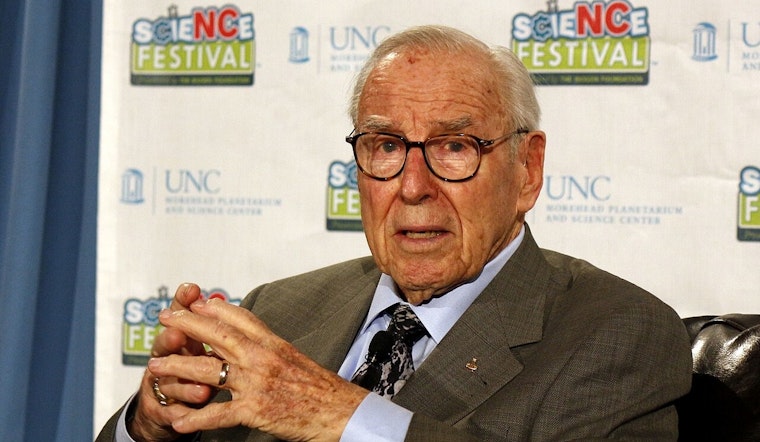
Jim Lovell, the seasoned astronaut revered for his leadership during the perilous Apollo 13 mission, passed away at the age of 97, NASA confirmed Friday. As the commander who averted disaster on a mission to the moon, Lovell's death symbolizes the end of era for America's early space exploration. According to NASA's statement, Lovell died on Thursday in Lake Forest, Illinois, leaving behind a legacy of fierce determination and ingenuity in the face of near-catastrophic circumstances.
Lovell's historic part as the command module pilot on Apollo 8 in 1968, the first human mission to orbit the moon and return, laid the groundwork for the subsequent moon landings. "Jim's character and steadfast courage helped our nation reach the Moon and turned a potential tragedy into a success from which we learned an enormous amount," NASA was quoted in an NBC Chicago report. The Apollo 13 mission in 1970, which Lovell commanded, suffered an oxygen tank explosion en route to the moon—a crisis that could have ended in loss but instead showcased human resilience and the power of teamwork.
Though largely remembered for the so-called "successful failure" of Apollo 13, Lovell's contributions to space exploration include his time on Gemini 7 and Gemini 12 missions as well. With a record of 715 hours, 4 minutes, and 57 seconds in space under his belt, Lovell has been a figure of lifelong dedication to the pursuit of knowledge beyond our atmosphere. "While you may have lost the moon ... you gained something that is far more important perhaps: the abiding respect and gratitude of the American people," President Bill Clinton said, according to NBC Chicago, when he awarded Lovell the Congressional Space Medal of Honor in 1995.
The drama of Apollo 13 resurfaced in public consciousness through the 1995 film "Apollo 13," where actor Tom Hanks portrayed Lovell. Despite the Hollywood portrayal, Lovell's own recollection of the mission underscored a profound success in human ingenuity. "Going to the moon, if everything works right, it's like following a cookbook. It's not that big a deal," Lovell explained in an interview with NBC Chicago. "If something goes wrong, that's what separates the mens from the boys." Reflecting on his commanding role during the Apollo 13 mission, NASA praised Lovell saying, "His calm strength under pressure helped return the crew safely to Earth and demonstrated the quick thinking and innovation that informed future NASA missions," as told to CBS News.
Lovell's family also released a statement, expressing their pride in his storied career and his role as the patriarch of their family. "We are enormously proud of his amazing life and career accomplishments, highlighted by his legendary leadership in pioneering human space flight. But, to all of us, he was Dad, Granddad, and the Leader of our family. Most importantly, he was our Hero. We will miss his unshakeable optimism, his sense of humor, and the way he made each of us feel we could do the impossible. He was truly one of a kind," Lovell's family conveyed in a statement shared by NASA, as reported by CBS News. Lovell is survived by his four children, who uphold his legacy as a pioneer of human spaceflight—a legend, not only in the halls of NASA, but in the hearts of those who dream of stars and beyond.





