

























































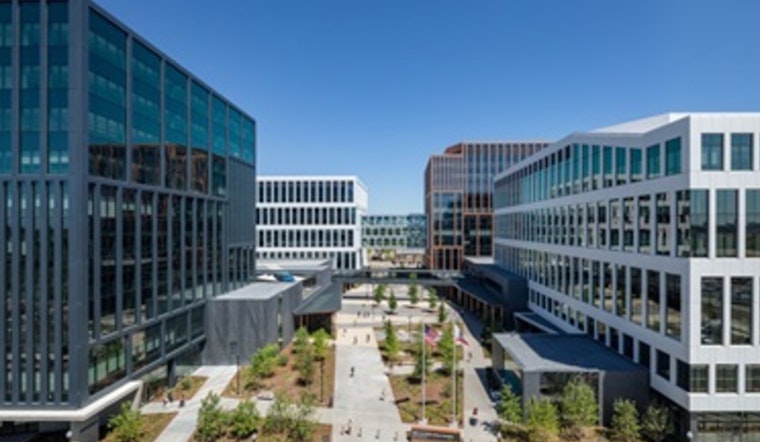
The California Department of Health Care Access and Information (HCAI) has decided to remain at its current South Natomas location rather than relocate to Sacramento's gleaming new May Lee State Office Complex. The decision has significant implications for both the agency's operations and the future of state government consolidation efforts in the Sacramento region.
According to the Department of General Services, the May Lee State Office Complex had a construction contract of $940 million, with total project costs reaching $1.03 billion. The complex stands as the largest all-electric, zero carbon workplace campus in the U.S., located in Sacramento's revitalizing River District at the key intersection of Richards Boulevard and North 7th Street.
The ZGF Architects designed complex was intended to provide a new home for 5,000+ employees in the state capital. Named after former DGS employee May Lee, the longest-serving state employee in California state history who passed away in 2023, the facility represents a massive investment in sustainable government infrastructure.
HCAI's Growing Mission
HCAI currently operates from multiple locations, with its primary Sacramento office at 2020 West El Camino Avenue. According to HCAI, the agency is "committed to expanding equitable access to health care for all Californians—ensuring every community has the health workforce they need, safe and reliable health care facilities, and health information that can help make care more effective and affordable."
The agency's current operations include investigating patient complaints and assessing administrative penalties against hospitals through its Hospital Bill Complaint Program. HCAI also established the Office of Health Care Affordability (OHCA) in 2022, which analyzes health care markets for cost trends and spending drivers while enforcing health care cost targets.
May Lee Complex Features
As reported by Kitchell, building tenants at the May Lee complex include the Department of Tax and Fee Administration and various departments within the Business, Consumer Services and Housing agency. The project features four mid-rise office buildings, amenities programs, landscaping, a parking structure, and opportunities for micro-mobility and public transit access.
According to DGS NewsWire, the facility leads in sustainability as one of the largest zero-net carbon facilities and features the most extensive all-electric kitchen in the country. The building includes 90 EV charging stations with capacity for more and was designed to reduce 5 million gallons of water annually.
Strategic Location Considerations
HCAI's decision to remain in South Natomas keeps the agency in an area that has been a traditional hub for state operations. As noted by Wikipedia, "South Natomas developed predominantly as residential subdivisions from the 1950s to the 1980s, but in 1982, amended its community plan to permit 2.4 million square feet of new office parks."
The area offers ease of access to major transportation corridors. Per Wikipedia, residents benefit from "ease of access to Interstate 5, Interstate 80, and the northern portion of Highway 99's route through Sacramento, making it a desirable living area for workers who commute."
Operational Flexibility
Despite staying in South Natomas, HCAI maintains operational flexibility across multiple venues. Recent public meeting postings show sessions scheduled for both "Online + Sacramento Office" and "Online + May Lee State Office Complex," suggesting the agency utilizes various locations for its functions.
The decision underscores the complex considerations state agencies face when weighing operational continuity, cost implications, and strategic positioning within California's evolving government infrastructure landscape. HCAI's choice to forgo the move represents a notable shift in anticipated consolidation efforts and may affect future state agency relocations to the substantial May Lee investment.





