

























































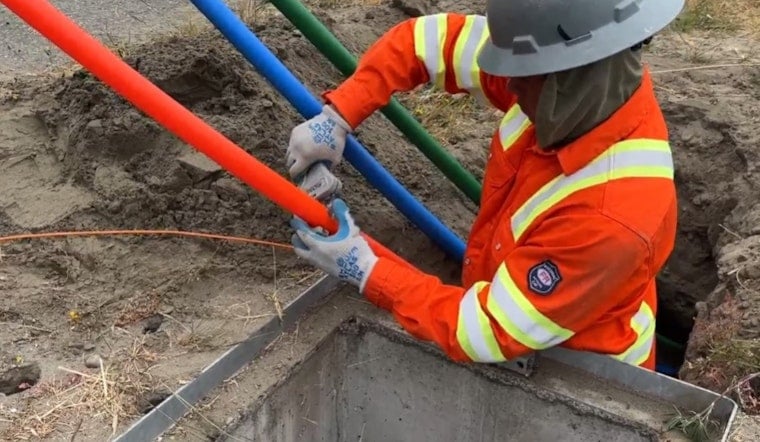
California's state-built middle-mile broadband backbone has almost tripled in size, now stretching 1,250 operational miles, Governor Gavin Newsom announced last Friday. The newly active segment forms a continuous route from San Jose down the Central Coast to Los Angeles, then east to Barstow and up into Modoc County. State officials say this milestone shifts the effort from pure construction into commerce, clearing the path for last-mile providers to bring service into homes, businesses and community institutions.
In a press release from the Governor of California, the administration said the network grew from 423 miles to 1,250 miles and is now open for business. California State CIO Chris Given said, "Reaching 1,250 operational miles is proof that California's Middle-Mile Broadband Network has moved from construction to commerce." CPUC President John Reynolds added that the expansion will help bring fast, reliable, affordable internet service to all Californians.
How much is built and what's left
According to the California Department of Technology, the Middle-Mile Broadband Initiative has completed or begun active construction on 5,549 miles, roughly 70% of an 8,100-mile system the state has planned. The program has leaned on joint builds, leases and upgrades to existing fiber to speed deployment and cut costs. That still leaves thousands of miles to be laid before the backbone reaches every remote community it targets.
Last-mile funding and how homes will connect
The operational segment is designed as a highway for last-mile projects that bring service directly into homes and community institutions. The California Public Utilities Commission runs the Federal Funding Account (FFA), a roughly $2 billion grant program aimed at those last-mile builds. The CPUC says it has awarded more than $1.2 billion in grants so far to projects that will benefit over 2 million Californians. Those awardees, along with commercial internet providers, will be the ones to hook neighborhoods into the state-built backbone.
Who’s already online
In April the Bishop Paiute Tribe became the first customer to connect to the Middle-Mile Broadband Network via a 423-mile Highway 395 segment, the governor's office reported in April. Tribal leaders credited the link with immediate improvements to students' online learning and access to telehealth. The state is positioning the backbone to support tribally run networks, local public projects and larger commercial providers.
Construction concerns and oversight
Not every community has watched construction roll through without concern. A June drilling operation tied to a middle-mile route in southern Humboldt drew scrutiny after return fluids clouded Redwood Creek and prompted an investigation by local and state agencies, according to Hoodline. Project filings and Caltrans encroachment documents on the state's CEQA portal show permitting and monitoring requirements for many middle-mile segments, and state officials say construction monitors, tribal coordination and environmental protections are part of the process.
What to watch next
State planning documents peg December 2026 as the target for completing the planned network segments, with progress and contracts reported in the California Department of Technology's legislative materials. Funding for the build is rooted in SB 156 and related appropriations that program officials say amount to roughly $3.25 billion for middle-mile construction, according to the California Department of Technology. The coming months will reveal whether last-mile grants and private providers can translate the new backbone into lower prices, faster speeds and new service for communities still offline.



